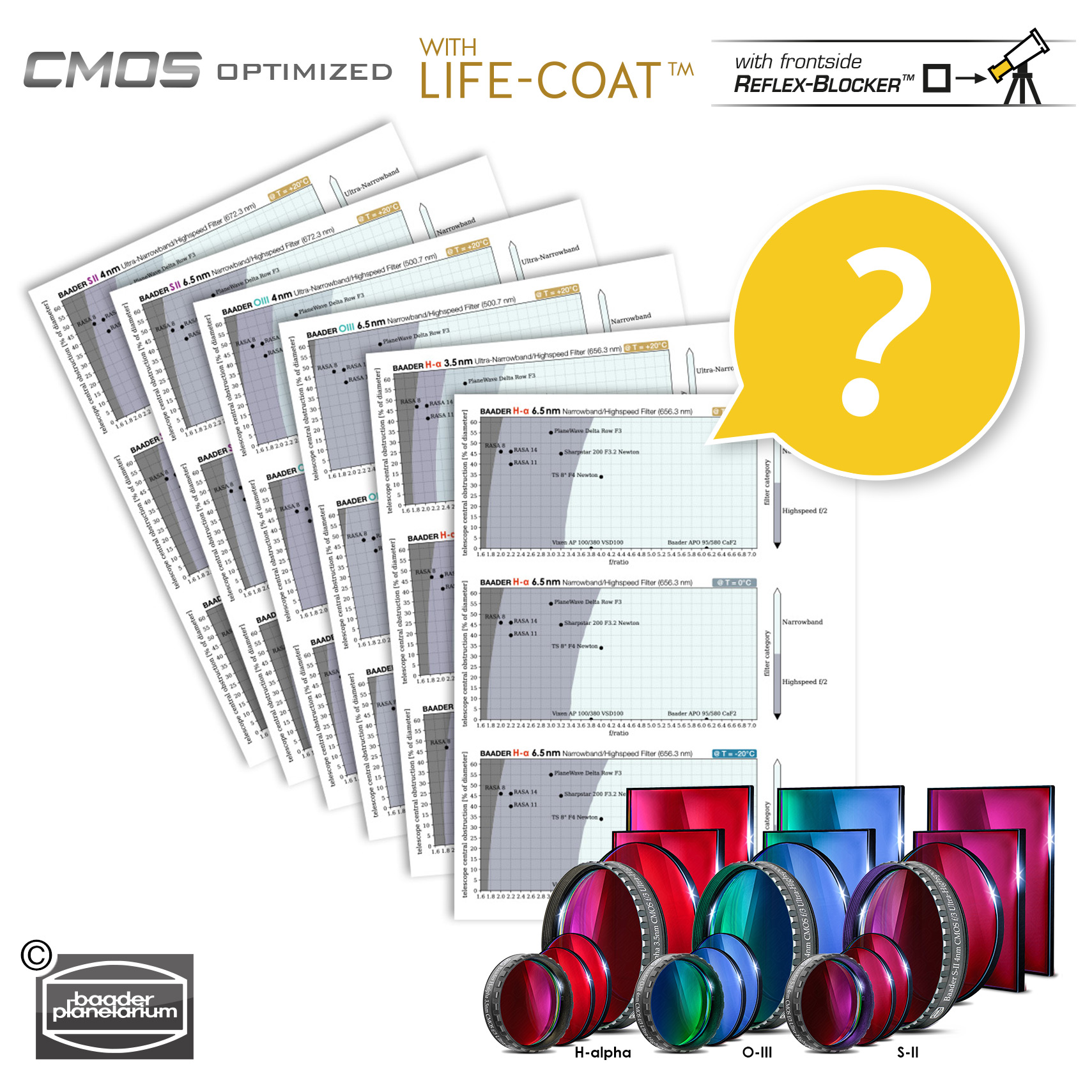
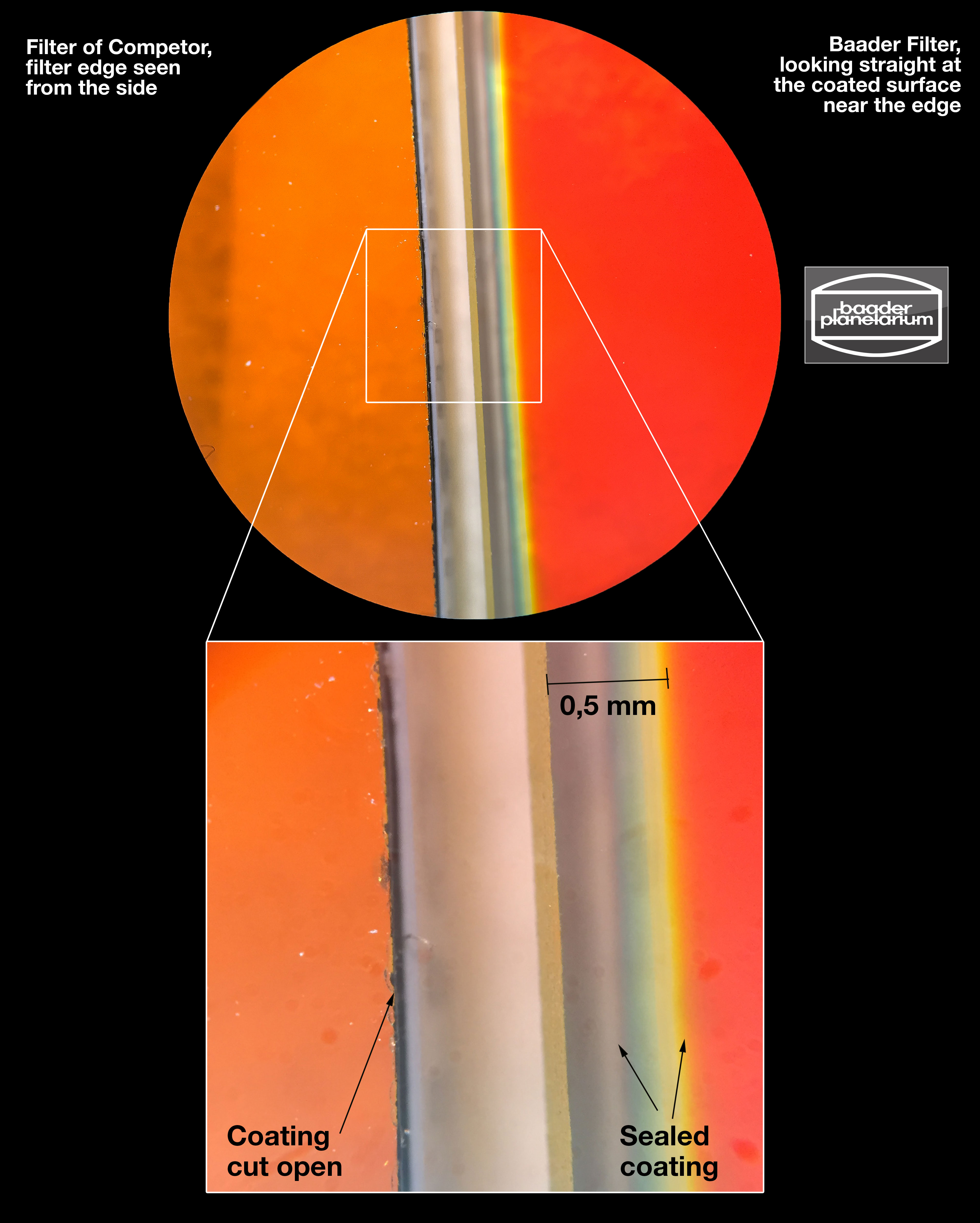
Die neue Generation von CMOS-optimierten Baader Filtern zeichnet sich aus durch:

CMOS-optimierte Baader Filter
Weitere Informationen, Testberichte und Bildergebnisse finden Sie hier:

3.5 / 4nm f/3 Ultra-Highspeed-Filtersatz 36mm – CMOS-optimiert (H-alpha / O-III / S-II)
Produktdaten
- Artikelnummer2961642
- EAN Code4047825051837
- HerstellerBaader Planetarium
- Nettogewicht (kg)0.01
Verwendung & Eigenschaften
- AnwendungsartCMOSCCDH-alphaO-IIIS-II
- Besondere MerkmaleCMOS-optimiert mit Life-Coat™
- Einzeln oder im Set?Filtersatz
Optische Eigenschaften
- DurchlassbereichH-alpha / O-III / S-II
- Filtertypf/3 Ultra-Highspeed
- Geeignet für Öffnungsverhältnisf/3.4 bis f/2.3
- HWB (Halbwertsbreite)3.5 nm (H-alpha) / 4 nm (O-III / S-II)
- Vergütung (Entspiegelung)Reflex-Blocker™ hartvergütetplanoptisch poliert
- ZWL (Zentralwellenlänge)656,3 nm / 500,7 nm / 671,7 nm
Mechanische Eigenschaften
- Filterdicke (ohne Fassung)2 mm
- Filterfassungungefasst
- Filterformrund
- Filtergröße36 mm
Empfohlene Blog-Beiträge






Customer Reviews
Top customer reviews
The filter set everyone with an f3 system should own
Before Baader released these filters, astrophotographers who shot with f/3 systems had a predicament. The f/3 focal ratio is fast enough to blue-shift the incoming light to such a degree that you would lose a lot of signal as the emission band is no longer centred on the band pass. At the same time, f/3 is not so fast that you could use filters specifically pre-shifted for f/2 systems such as Rasa or HyperStar without running into the same issue on the other side of the band pass. So you basically had three choices.
The first option was to shoot with 7nm filters as they have a wide enough band-pass to accommodate for the blue-shift. This is not an ideal solution as the whole point of owning a fast system is to maximise your signal-to-noise ratio and reduce integration time (ignoring aperture size as the majority of astrophotographers are limited by seeing and guiding rather than by diffraction). Why bother paying for a fast system and struggling with collimation and tilt if you could get a similar SNR shooting with 3nm filters on a slower system?
The second option would be to try your luck with 5nm or 3nm filters anyway. This would usually result in an even worse SNR than shooting with 7nm filters due to the blue-shift.
The last option is to order custom made filters from Chroma which are specifically pre-shifted for f/3 systems. This is what you’d probably do if you were shooting with a PlaneWave Delta Rho or Officina Stellare Veloce but I didn’t even bother enquiring with Chroma how much this would cost as I’d probably have to sell my car to pay for them.
By coming out with these f/3 filters, Baader have done a great service for the astrophotography community by enabling people who own f/3 systems to finally get the most out of their setup. I own a Sky-Watcher Quattro 200P with a Starizona Nexus and as soon as I found out these filters existed I knew I had to have them. When it comes to performance, they blow my 7nm ZWO filters out of the water. I’ve never owned Chroma or Astrodon filters but I struggle to see how they could perform too much better than these Baaders. Halos are very minimal for my particular setup. Although I did observe halos when shooting Sirius, I saw no halos at all on a 10-minute sub-exposure of Alnitak.
Below I’ve attached two 3-minute sub-exposures (cropped) of NGC 3576 shot in Bortle 5 skies during similar moon phases. One was taken with a ZWO 7nm HA filter and the other was taken with the Baader 3.5nm HA filter. I don’t think I need to specify which is which. The difference is night-and-day. The Baader has significantly more contrast and detail in the nebulosity thanks to the narrower band pass letting in half of the light pollution. Even the stars appear tighter with the Baader filter although I admit my collimation was slightly off for exposure taken with the ZWO filter.
These filters are definitely a must-have for anyone shooting with an f/3 system.

Thank you most kindly for your (unsolicited and unexpected) endorsement! We really appreciate your opinion.
Actually we were forced to go that route. It was a somewhat "sobering experience", when early in summer 2021 we proudly presented the all new CMOS-optimized (Ultra-) Narrowband/Highspeed Filters and had to learn that indeed this "f/3 filter-gap" can only be addressed in all decency by creating a new f/3 filter category - for the Ultra-Highspeeds only. And obviously you are aware about the prices elsewhere, where such a set of f/3 centered filters must be ordered as a special product.
We absolutely agree that it may bring additional trust, to include a protocoll with each filter. And please be assured that we DO measure each and every Narrowband-filter here in house, not just for the correct transmission and preshift, but also for the absence of halos. We discussed this protocoll issue multiple times, but the administrational effort is so time consuming that filter prices would have to rise considerably. We do suspect that the prices of some noteworthy competitors are so much higher than ours for this very reason.
In the end we must try to offer the most competitive prices for our products and better rely on the trust that our customers may give us, based on our 57 years of company history. We are all humans and may make mistakes. but in case this happens we are here to help and won´t run away...
Nothing else like them on the market
Including individual spectrograph measurements with each filter sold with further boost buyer confidence.
Andreas H. / 17. November 20221 Antwort