A Detailed Article by Dipl.-Ing. Wolfgang Paech
With very few exceptions—such as dust storms on Mars or phenomena in Jupiter’s upper atmosphere—our Sun is the only astronomical object available to amateur astronomers that changes every day and, in some cases, even from minute to minute, as is the case with prominences. Occasionally, it presents an entirely new appearance. All structures observable on the Sun originate in the Sun’s magnetic field.
At least in so-called “white light” or continuum light, observing the Sun does not require any special instrumentation or particularly expensive accessories. Small telescope apertures are sufficient for observing many solar structures. Drawing on almost 50 years of solar observation, the author would like to provide an overview of all the phenomena that amateur astronomers can observe on the Sun and encourage you to explore the fascinating field of solar observation.
For amateur astronomers, only three spectral regions are relevant for observation: wavelengths of 393.4, 540 and 656.28 nanometres (see: *Wavelength of Light), which pass through the Earth’s atmosphere without difficulty.
A closer look at these three spectral regions reveals the Sun as a kind of onion-layer model, with the individual layers also corresponding to different temperatures. However, depending on the pressure conditions and the position of the magnetic fields, these layers may also intermingle.
Here you will find example images of each individual solar structure that can be observed by amateurs at specific wavelengths, together with a brief description of the physics behind the respective structures. We also provide direct links to the Baader accessories required for observation.
Continuum
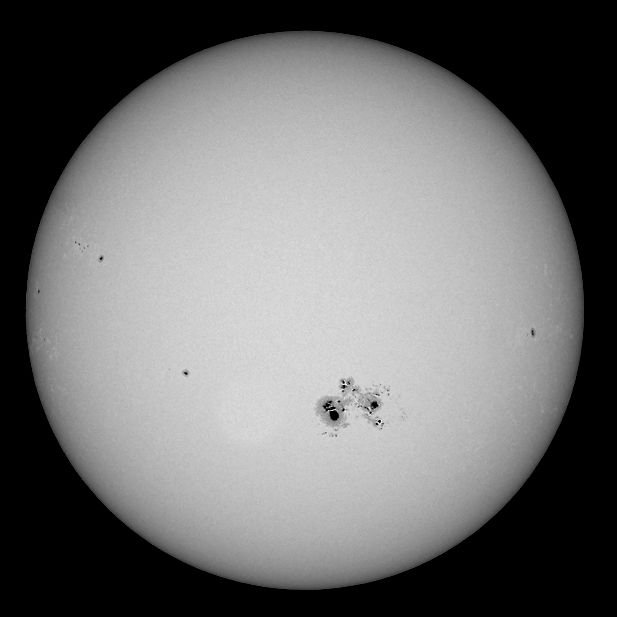
The lowest layer is the so-called white-light Sun. Observations are normally carried out in the visible spectral range between approximately 400 and just under 700 nanometres, to which the human eye is also sensitive. This layer of the Sun is known as the photosphere. It is only approximately 400 kilometres thick and emits a large proportion of the Sun’s light. The photosphere has a temperature of approximately 5,500 degrees Celsius. Layers below the photosphere, such as the convection zone, are NOT accessible to amateur astronomers through observation.
Solar Structures observable in the Continuum
Baader-Accessoires for Solar Observation


Calcium
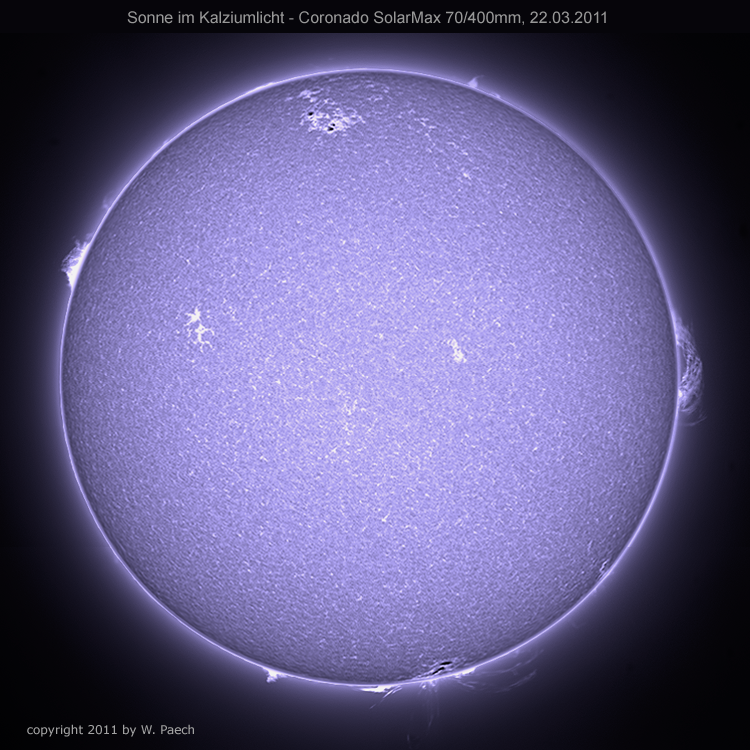
ABOVE the photosphere lies the calcium image of the Sun. Since very little light is emitted at a wavelength of 393.37 nanometres, extremely narrow-band filtering with a bandwidth of 1 to 2 Å is required. Otherwise, the calcium image would be completely overwhelmed by the light from the photosphere, or continuum.
The human eye is practically insensitive in this spectral region, which means that observations can ONLY be made photographically.
This layer of gas is also very thin and extends only to a height of approximately 500 kilometres above the photosphere. It therefore forms a transitional layer between the upper photosphere and the lower chromosphere.
Solar Structures observable in calcium light
Baader-Accessoires for Solar Observation

H-Alpha
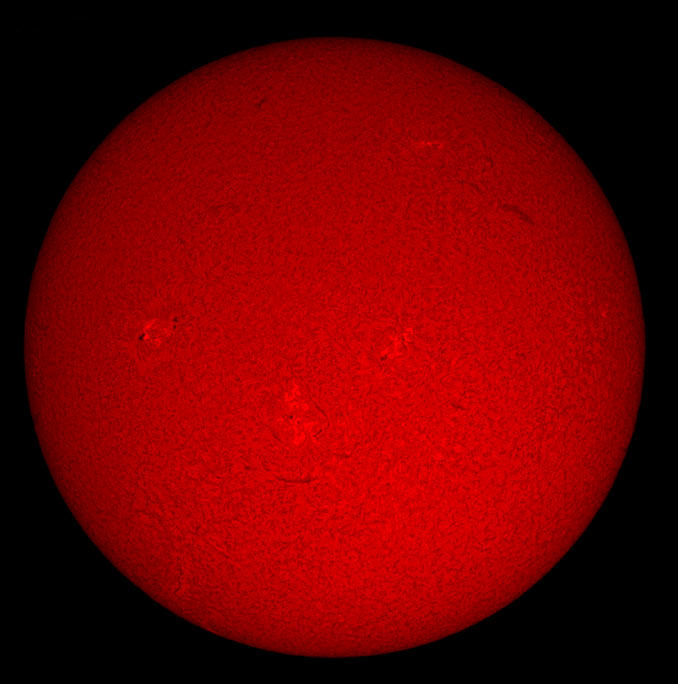
ABOVE the calcium layer lies the H-alpha Sun at a wavelength of exactly 656.28 nanometres. This layer of gas is also known as the chromosphere, from the Greek word chroma, meaning “colour”. It is several thousand kilometres thick and, in its outer regions, forms the transition to the solar corona, which can normally only be observed during total solar eclipses.
Until the 1960s, parts of the inner corona could also be observed by amateurs outside solar eclipses using specialised filters. Today, this is no longer possible because of steadily increasing air pollution.
The temperature of the outer chromosphere already reaches several tens of thousands of degrees Celsius and then rises to between one and two million degrees in the corona.
For amateur astronomers, the H-alpha Sun is the most exciting area of solar observation, as structural changes can be observed from minute to minute. Anyone who has watched an eruptive prominence rise to a height of several hundred thousand kilometres live through an eyepiece is unlikely ever to forget the experience.
Solar Structures observable in H-alpha light
Baader-Accessoires for Solar Observation
Detailed information on solar structures and the Baader accessories required for observing the Sun in calcium light is available here as a german PDF file.

„Lucky Imaging“ Technique
Some of the solar structures described here can be observed much more clearly photographically than visually through an eyepiece. References to photographic observation do not relate to individual digital images, but to image capture using video cameras and the “lucky imaging” technique.
A detailed description of solar photography using video cameras and the “lucky imaging” technique can be found on the following Baader website: astrosolar.com
A Brief Introduction to Instrument Technology
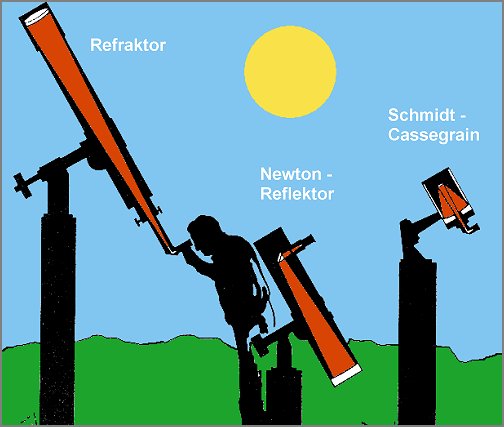
The fundamental challenge of solar observation is the enormous amount of light and the resulting heat load near the focal point, which also depends on the telescope aperture. Regardless of the spectral region being observed, the sunlight must be filtered to a safe and manageable level.
In general, filtering can take place either IN FRONT OF the telescope aperture or shortly BEFORE the telescope’s focal point.
All telescopes containing optical components inside the tube, such as secondary or deflecting mirrors—including all types of reflecting telescopes such as Newtonian, Maksutov, Ritchey-Chrétien and Schmidt-Cassegrain systems—MUST be filtered IN FRONT OF the entrance aperture. Otherwise, unfiltered sunlight enters the telescope tube, and the resulting heat may damage the mirrors and/or their mountings.
Refractors with a straight, unobstructed optical path can be filtered either in front of the objective lens or shortly before the telescope’s focal plane. Specific information on suitable filtering methods is provided in the sections covering the respective spectral regions.
ALL solar white-light structures accessible to amateur astronomers through visual observation can be observed with telescopes with apertures of 100 mm or more.
The smallest structures visually accessible to amateur astronomers are granulation cells, which have an apparent size of approximately 2 to 3 arcseconds. For observing photospheric structures, a telescope aperture of 150 mm represents a practical upper limit. Photographic imaging can achieve a significantly higher resolution of less than one arcsecond.
In calcium and H-alpha light, even telescopes with apertures of approximately 80 mm reveal an astonishing wealth of detail.
Further information, including details of special filtering methods, is provided in the sections covering the three spectral regions accessible to amateur astronomers.
* Wavelength: The wavelength of light is specified in nanometres [nm], with 1 nanometre equalling 1 × 10⁻⁹ metres. Visible light ranges from approximately 390 nm in the dark-violet region to 700 nm in the dark-red region. The transmission bandwidth, or full width at half maximum [FWHM], of very narrow-band filters is specified in ångströms [Å], with 1 nm corresponding to 10 Å.