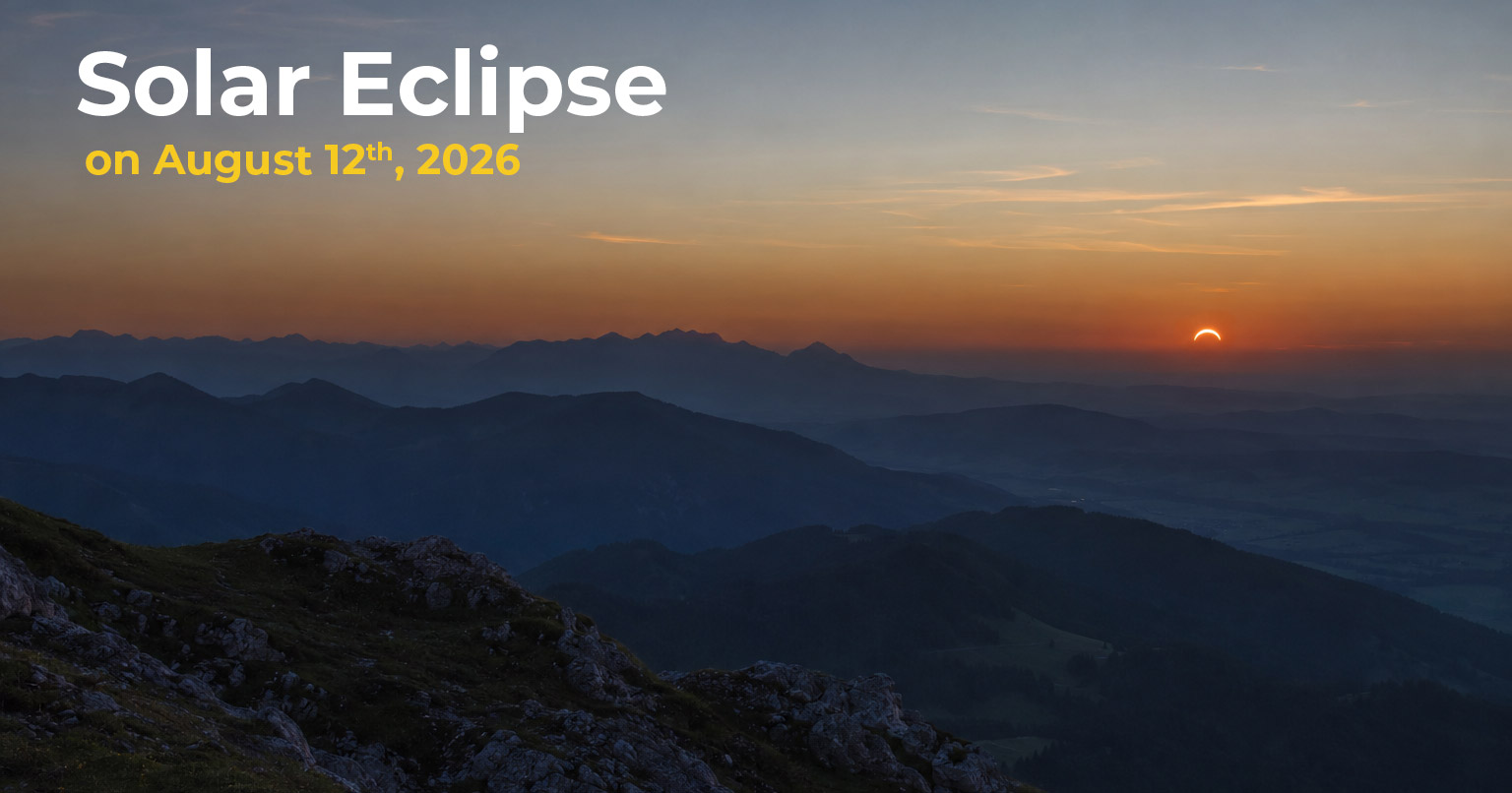
On 12 August 2026, the Moon's umbral shadow will pass over Greenland, Iceland and Spain. While a total solar eclipse will be visible there, Germany will experience an impressive partial eclipse. In the Munich area, the event will begin at around 7:22 p.m. Maximum eclipse will occur at approximately 8:15 p.m. – only a few minutes before sunset at around 8:32 p.m. At that time, about 89 percent of the visible surface of the Sun will be covered by the Moon. Local eclipse data for Munich
The unusually low position of the Sun makes this eclipse particularly appealing – but also challenging. Anyone wishing to observe the maximum will need more than simply an unobstructed view to the west: the horizon must be as clear as possible towards the west-northwest.
At maximum eclipse, the Sun will be only just above the horizon
In the Munich and Mammendorf area, the Sun will be only about 2 to 2.5 degrees above the horizon at maximum eclipse. The viewing direction will be at an azimuth of approximately 290 degrees – significantly farther north than due west.
The ideal observing site should therefore meet the following requirements:
- an unobstructed view between approximately 285 and 295 degrees
- no nearby trees, buildings, masts or terrain features in this direction
- a position that is as elevated as possible relative to the surrounding area
- a publicly accessible and safely reachable location with good parking facilities
- sufficient space without blocking roads, farm tracks or agricultural land
A compass app on a smartphone is sufficient to check the viewing direction on site.

This may initially sound like a minor detail, but it determines whether the narrow solar crescent remains visible. A row of trees about 20 metres high at a distance of 500 metres already occupies approximately 2.3 degrees of the horizon. It could therefore completely obscure the Sun at maximum eclipse.
Why the low Sun is attenuated more strongly
When the Sun is high in the sky, its light passes through the atmosphere along a relatively short path. Near the horizon, by contrast, the light travels a very long distance through the air close to the ground.
At a solar altitude of around 2.35 degrees, the optical path through a simplified standard atmosphere is approximately 18 times longer than that of the Sun at the zenith. Even at a solar altitude of 5 degrees, the path still amounts to about ten so-called airmasses.
Along this path, sunlight is attenuated by several processes:
- Even thin layers of cloud can cause the narrow solar crescent to disappear completely.
- Molecules scatter primarily the shorter-wavelength blue components of the light.
- Aerosols, dust and haze reduce contrast.
- Water vapour can further reduce transparency near the horizon.
The decisive factor is the long path through the humid and often hazy lower troposphere. Visibility can therefore vary considerably from one day to the next – or even within a few minutes.
Why the filter film becomes particularly important when the Sun is low
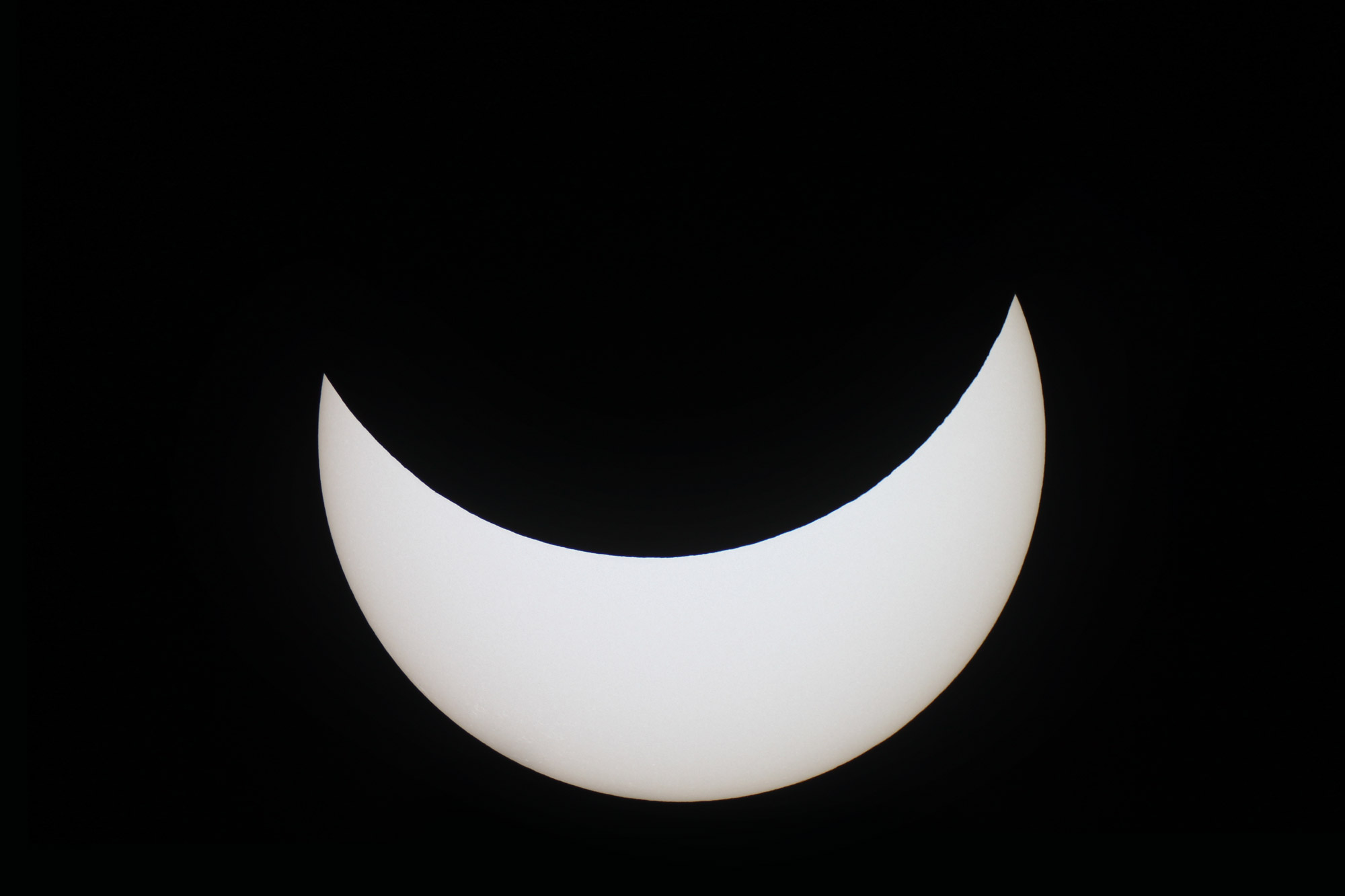
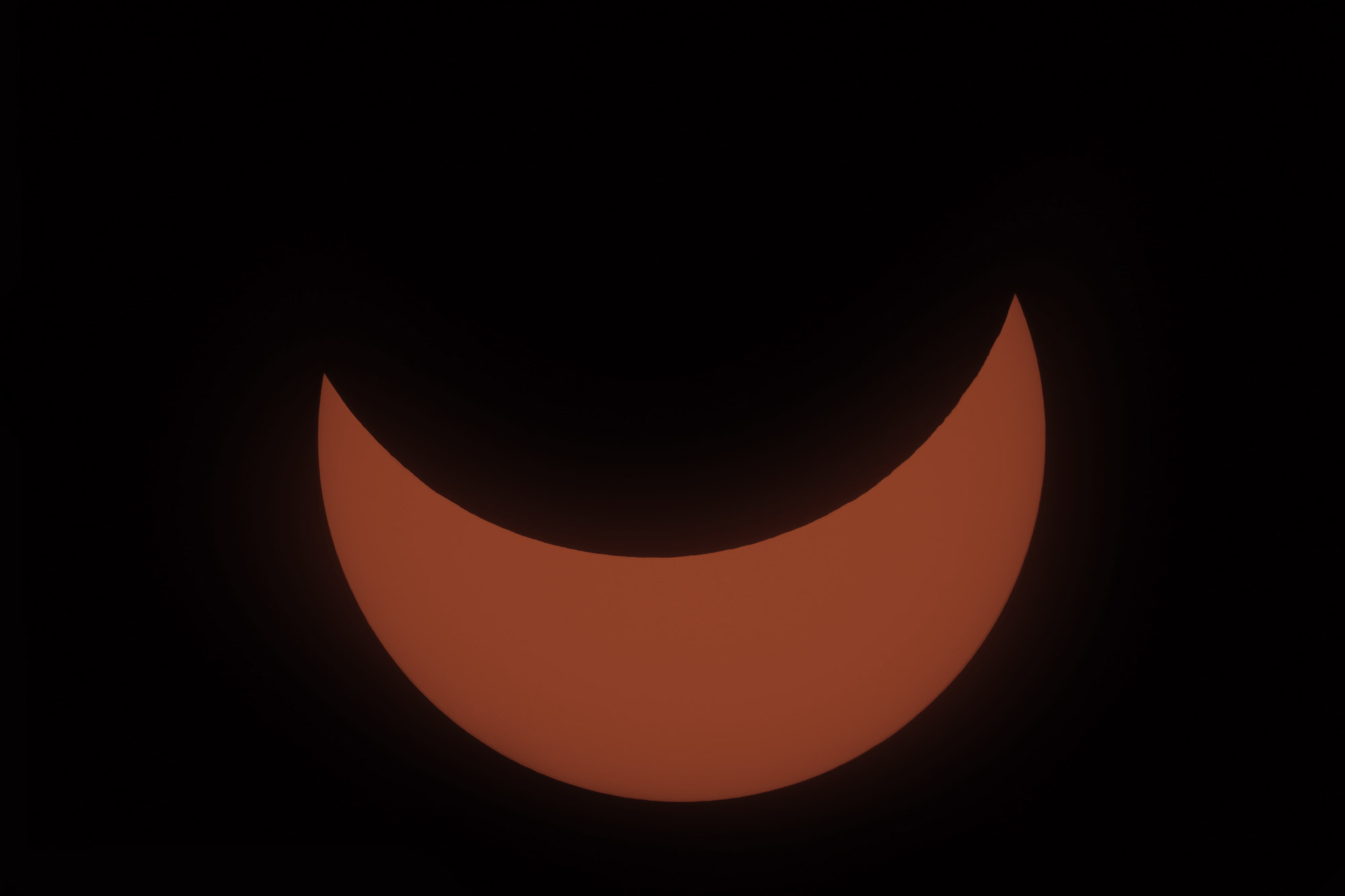
Many particularly inexpensive solar eclipse viewers produce a strongly yellow, orange or reddish image of the Sun. Some of these products use thick, highly absorbent, dark-brown films that are sometimes metallised on only one side.
Such filters can suppress a large part of the visible spectrum and transmit predominantly red light. When the Sun is high in the sky, the solar image is often still sufficiently bright. Near the horizon, however, this strong and colour-selective filtering coincides with the additional effects of atmospheric extinction.
As a result, the already attenuated solar crescent may appear very dark, low in contrast or only faintly visible. If haze or water vapour is also present, it may disappear from view entirely.
The following images show the Sun during the partial solar eclipse of 2015. At that time, the Sun was high in the sky; on 12 August 2026, the solar images are likely to appear considerably darker.
Our
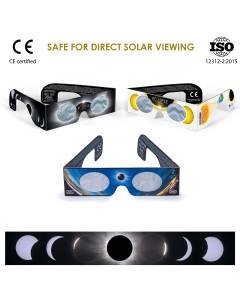 Solar / Eclipse Viewer AstroSolar® Silver/Gold (various Designs / Quantities)
(various versions available)
use a different technical approach.
The film makes much more even use of the full visible solar spectrum from approximately 400 to 700 nanometres. This produces a largely neutral-white and natural-looking image of the Sun instead of restricting perception predominantly to a narrow red portion of the spectrum.
The key features:
- colour-neutral representation of the Sun
- no carbon-based light attenuation
- special pigmentation with UV inhibitors
- durable filter surface metallised on both sides
- low-reflection viewing characteristics on the eye-facing side
- OD 5.0 – reduction of solar intensity by 99.999 percent
- protection against UV and IR radiation
- CE/ISO certification in accordance with EN ISO 12312-2:2015
Further technical information can be found on the product page for the Solar / Eclipse Viewer AstroSolar® Silver/Gold (various Designs / Quantities) (various versions available) .
In addition to the official CE certificates that have been in place for many years, our solar eclipse glasses have now also been tested by a Spanish market surveillance authority. The result: every single test criterion was passed. Please refer to the original Spanish document shown alongside this text.


Because a larger proportion of the visible spectrum contributes to perception, a greater visual reserve remains available when the Sun is low. This is a clear advantage both during the solar eclipse in Spain – where the Sun will be only a few degrees above the horizon at many locations during the partial phases – and during the partial eclipse over Munich.
Of course, the same limitation applies here: no solar eclipse viewer can see through clouds. In very dense haze, even AstroSolar® Silver/Gold may provide only a faint image of the Sun or none at all.
Safety first!
The Solar Viewer AstroSolar® Silver/Gold are intended exclusively for direct solar observation with the unaided eye.
Never look through unfiltered binoculars, a telescope, a camera lens or a spotting scope while wearing solar eclipse viewers. The optical system concentrates the sunlight and can destroy the filter film within a very short time.
For binoculars, telescopes and camera lenses, a suitable solar filter must be securely mounted in front of the objective lens. The AstroSolar® ClearWhite Safety Film OD 5.1, for example, is suitable for constructing such front-mounted filters, as are our mounted Baader Solar Filters.
Please also observe the following safety rules:
- Inspect the viewer for holes, tears or other damage before every use.
- Put the viewer on before turning your head towards the Sun.
- After observing, first look away from the Sun and only then remove the viewer.
- Supervise children throughout the entire observation.
- Never use ordinary sunglasses as a substitute.
- Always observe the partially eclipsed Sun using suitable protection – even immediately before sunset.
Detailed general guidance is provided by the American Astronomical Society on safe solar viewing.