Anyone interested in our solar system can look forward to an exceptionally beautiful constellation this winter: the four brightest planets are visible to the naked eye at the same time in the evening sky, and two more planets can be spotted with binoculars and a telescope.
Immediately after sunset, Venus appears brightly shining at -4.7mag in the dark blue sky in the west, with the ringed planet Saturn significantly fainter to the left above it. High in the south is Jupiter with -2.6mag in a yellowish white light, in the east the red planet Mars shines orange with -1.3mag. What the planets have in common is that they do not “flicker” like stars, as their light does not emanate from a point source, as is the case with the much more distant stars, but from a flat disk.

As if suspended on a string, these four bright planets form a chain that traces the ecliptic - the plane of the orbits of the planets in our solar system.
Uranus and Neptune cannot be seen with the naked eye. With a telescope and a more detailed star chart, you will find Neptune to the left above Saturn, the slightly brighter Uranus is to the right above Jupiter.
For terrestrial telescope observers, 2025 is a special year for three of these planets:
- Saturn: We are looking at the edge of its rings, which only happens every 15 years or so. The rings are currently just a thin line and almost invisible in small telescopes. This makes it appear less spectacular at first glance, but offers some interesting effects for owners of somewhat larger telescopes. Because only when Saturn and Earth are in this position do Saturn's large moons pass in front of or behind the planet (instead of above or below it), casting their shadows on it and themselves being covered by Saturn's shadow. You can find a very good explanation and summary on https://www.waa.at/hotspots/planeten/saturn-2024-2026-titan-transits/
- Mars: The red planet reached its opposition position on January 16, which means it is exactly opposite the sun near the earth. As its orbit is elliptical and not circular, it is significantly further away from the Earth this year than at the last opposition and is therefore quite small in the telescope at 15 arc seconds. With a powerful telescope with an aperture of around 8 inches or more, it is still possible to see some details on the planet. The view changes over the course of the evening and even more over the course of several days, as Mars has a slightly faster rotation time of 24 hours and 37 minutes than our Earth. It is spring in the northern hemisphere of Mars. The large north polar cap can be seen very clearly, it is currently thawing.
- Jupiter is very high in the sky and can therefore be observed more clearly and distinctly in telescopes than it has been for almost a decade, which is due to its orbital period around the sun (11 years). Even with telescopes with an aperture of approx. 10 cm or more, you can see the Great Red Spot (the largest storm in the solar system) as well as other spots and storms in addition to the dominant brown and white cloud stripes.
Our customer Michael Karrer has sent us some photos that he has taken in the last few weeks with his Celestron C14 on an AstroPhysics GTO 1100 Mount. They exemplify what a technically well-equipped and very experienced astrophotographer can take these days. With his C14 telescope he can resolve many details of the surface of Mars. Jupiter with the large red spot and a plethora of other cloud structures is reminiscent of images taken with the Hubble telescope. The photo of Saturn shows the rings near the edge and the moon Titan, which lies behind the planet and is covered by its shadow.
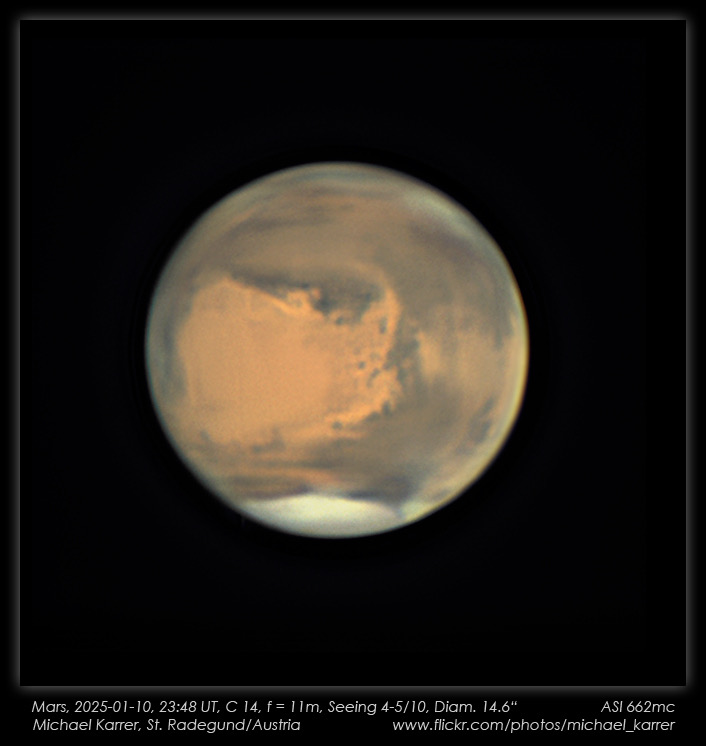
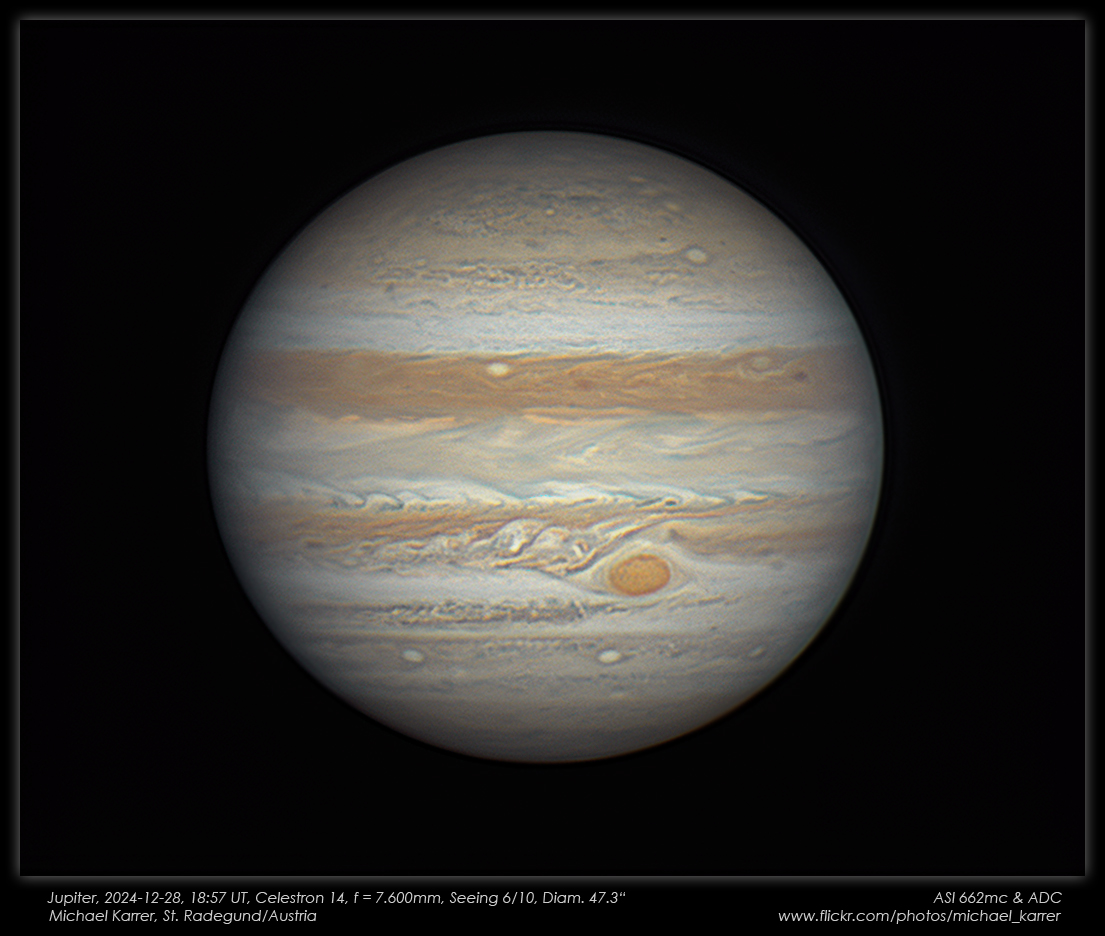

If you look at these outstanding high-tech photos and then look through a telescope, you will of course be disappointed by the visual sight. Even in larger devices, Jupiter cannot be seen in the richness of detail that results from the elaborate “lucky imaging” process, i.e. the summation of many short-exposure individual images and subsequent post-processing.
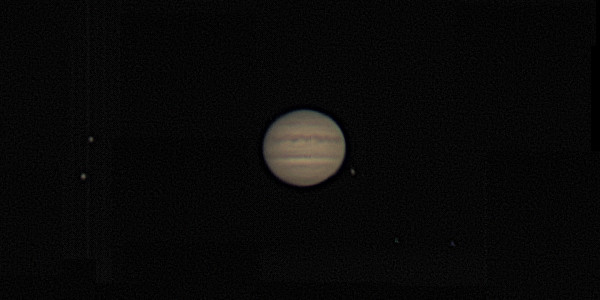
But looking at a planet yourself, coming into direct contact with it, imagining that its light has crossed half the solar system to land in your own eye, has a special fascination. The constellation of planets in the winter sky therefore offers something for everyone, regardless of whether you just enjoy the view with the naked eye or try to see the details or even photograph them with a telescope.
We hope you enjoy your planet hunt!
Quick Look at the sky in 2025
In ourLook at the sky for 2025 you will find detailed information on the total lunar eclipse, several planetary oppositions and significant meteor streams such as the Perseids and Geminids, as well as product recommendations.