Help to explore the Venus cloud discontinuity!

The portal „spaceweather.com” has posted a very interesting report that is linked to a call to all planetary photographers.
It has only been known since 2016 that there is a kind of “cloud wall” in the atmosphere of Venus. This poses a puzzle for researchers. No other planet is known to have a similar cloud effect. In addition, the atmosphere of Venus rotates about 60 times as fast as the planet itself. Due to this and the extreme currents in the hot and dense atmosphere, such a structure should not be able to survive for long. But it appears again and again. What causes the cloud wall? What effects does it have on the rest of Venus' cloud cover? Why does it keep coming back? These and many other questions can only be answered by regularly monitoring Venus over a long period of time. The research could yield interesting results that can also be transferred to the Earth's atmosphere.
However, the wave can only be photographed by space probes on site - or by terrestrial telescopes with special filters. Even ambitious amateur astronomers can image the effect with our SLOAN filters. In an earlier article, we had already referred to the use of SLOAN filters on Venus, but at that time it was not yet clear what significance this technology would have today:
 Amateur Astronomers take a look through the Cloud Cover of Venus with our SLOAN Filters 09. June 2022 - Amateur astronomers successfully explore Venus with Baader SLOAN Filter Even today, amateur astronomers can still contribute to scientific research. For example, our new photometric filters now open another window into the depths of the atmosphere… Read more
In the meantime, the Japanese space probe Akatsuki has fallen silent. This leaves only terrestrial observations to further explore the hitherto unexplained phenomenon. Professional observatories lack the telescope time for the necessary regular observations, so this is an exciting opportunity for amateur astronomers to contribute to scientific research.
The leading researcher in this field, Dr. Javier Peralta, is calling for reports and photos to be sent to him at http://pvol2.ehu.eus/pvol2/news/view?id=49.
The right Tool: Baader Sloan Filters
With our SLOAN filters, the Venus cloud discontinuity can already be photographed with good amateur telescopes - an application example that we are extremely pleased about!
It shows the beginning of a development that will also become possible for normal astrophotography with the help of SLOAN filters.
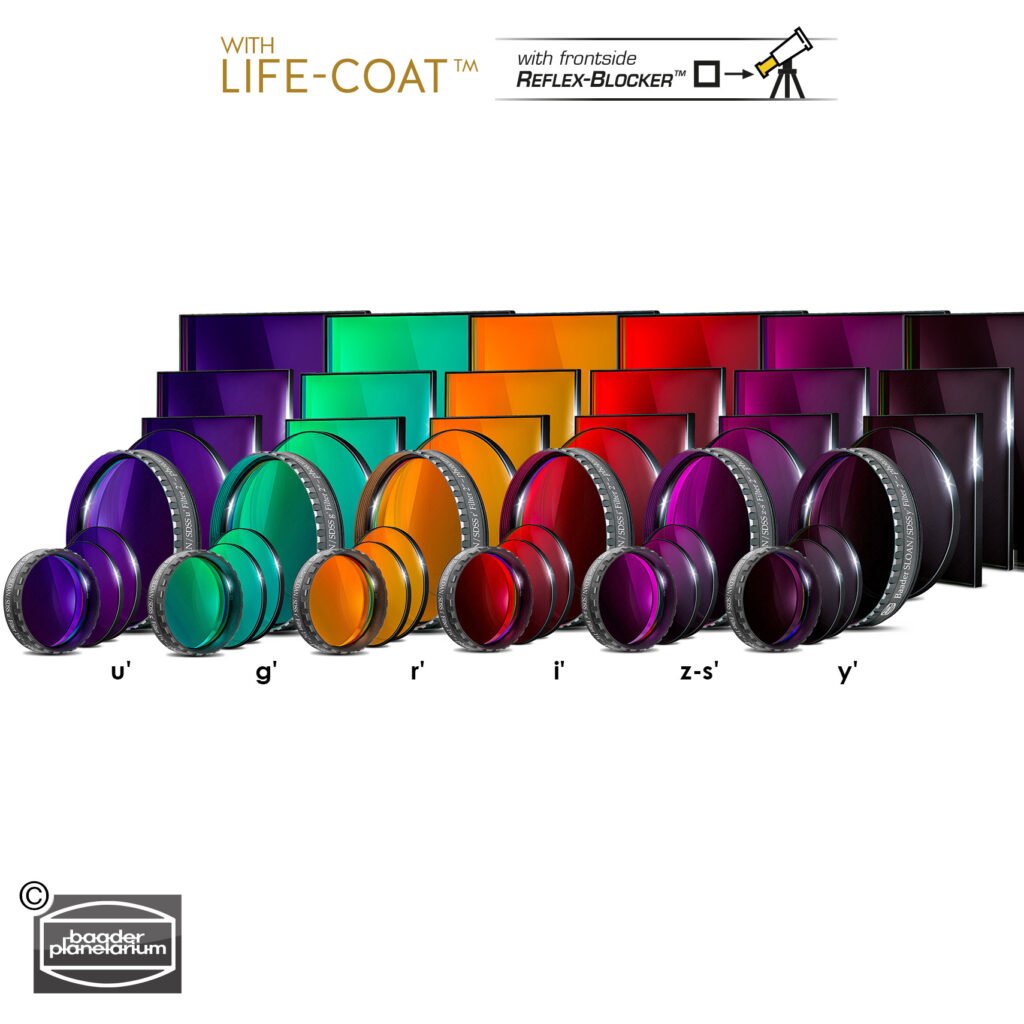
We are often asked (sometimes even with mild reproach) why we chose the Sloan I filter in the “Z-s” and “Y” standards when selecting the available SLOAN passbands. The monitoring of the Venus clouds has shown very impressively the practical benefit of the decision to choose two filters in the infrared and not to cover the entire NIR range in one filter.
Of course, we have “aimed” a little at the needs of normal astrophotographers, because a filter with a transmission range of ~ 820 nm to 930 nm (
 Baader SLOAN/SDSS z-s'-Filter – photometric
(various versions available)
had not been available before - with so steep slopes. However, this wavelength range is extremely interesting for planetary photography and other astronomical applications, as is the SLOAN-Y filter:
 Baader SLOAN/SDSS y'-Filter – photometric
(various versions available)
with a transmission of only ~ 930 to 1060 nm.
These two filters form the basis which, among other things, should make it possible for a future generation of so-called “super-apochromats” to be used at all. At the moment, the apochromatic color correction of even the best lens telescope generally only extends from 400 to ~700 nm. There are already good optical calculations and some somewhat exotic lenses that would be perfectly corrected up to wavelengths of 1000 nm - but so far there have been no suitable filters that could help to extend the RGB scheme into the NIR range, for example. However, the shift into the NIR spectral range will be forced in the long term by the ever-increasing LED light pollution!
RGB filters are known to have a transmission range of approx. 100 nm transmission width. It is precisely this width that is now extended by these two separate SLOAN filters in such a way that harmful wavelengths are also excluded. This opens up completely new photographic possibilities for the ambitious amateur in the future - and at the same time both filters correspond to the standard SLOAN scheme for spectroscopes.
Be prepared - Venus will soon be visible again!
Although Venus is currently barely visible in the daytime sky, it will soon appear in the evening sky in the west and, as the third brightest natural celestial object after the sun and moon, will once again be the subject of many UFO reports at public observatories. What is particularly interesting is that Venus will even be visible in the evening and morning sky for a few days in March for observers in higher northern latitudes.
Don't miss the opportunity to contribute to current research with your telescope! We would be delighted to receive image submissions from you on this topic, which we would be happy to publish on our website.