We are often asked by customers how eyepiece projection can be done with modern, large wide-angle eyepieces.
With eyepiece projection, the eyepiece basically replaces a Barlow lens and makes it easy to achieve very high magnifications on a telescope or spotting scope. Today, it is mainly used if you want to take photos with a DSLR or mirrorless camera on optics where the eyepiece can't be removed, or where there is insufficient back focus, as it is often the case with spotting scopes. Many of our eyepieces - especially the Hyperion 8-24mm zoom, which is also very popular with nature observers and compatible with many spotting scopes - therefore have an integrated M43 thread for connecting T-2 photo accessories (the large eye lenses of many of our eyepieces do not allow a T-2 thread to be integrated directly into the eyepieces). We describe various camera adaptations in our digiscoping brochure.


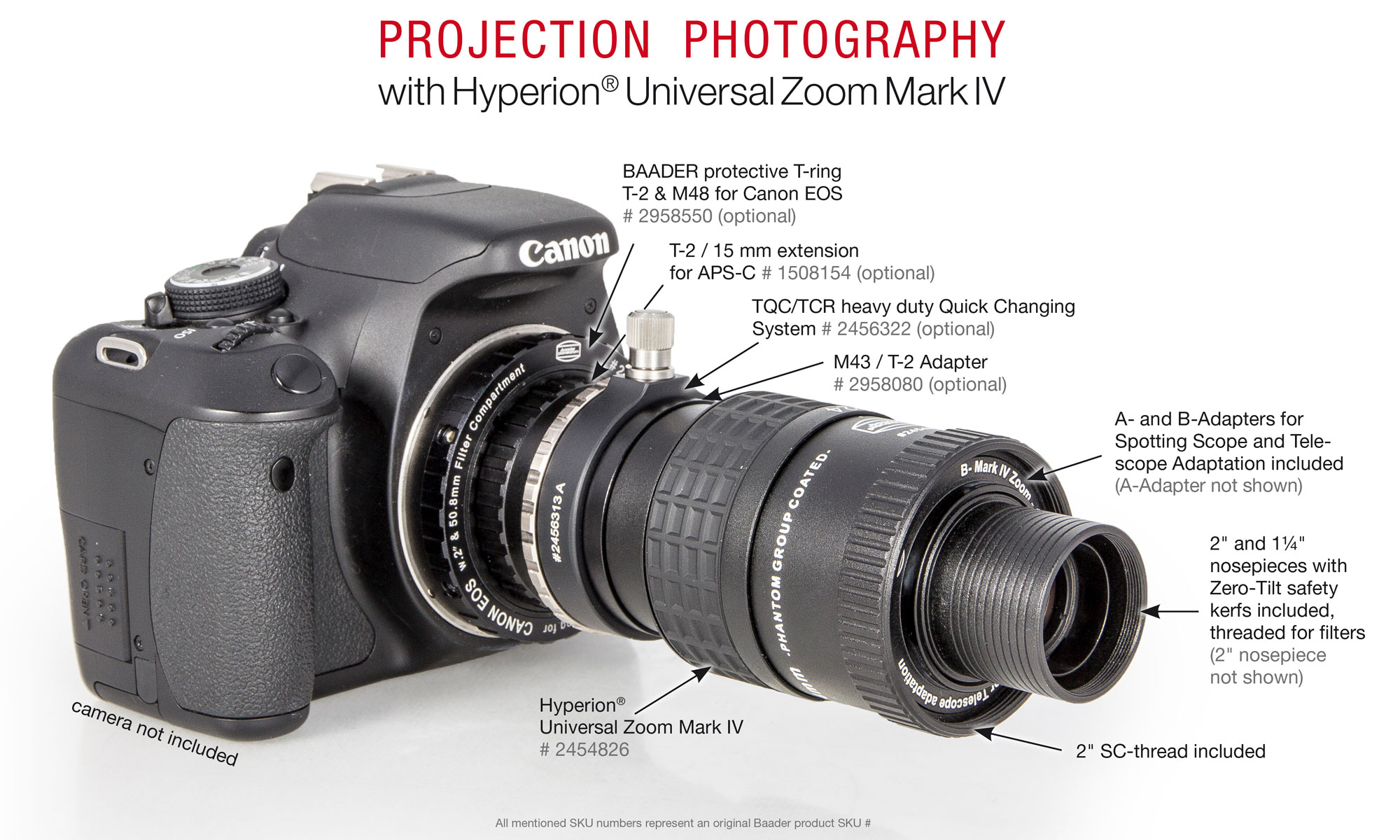
On a telescope eyepiece, the camera is attached to the eyepiece in the same way. It is important to take care of the correct spacing between eyepiece and camera sensor to avoid distortions at the edge of the field of view.
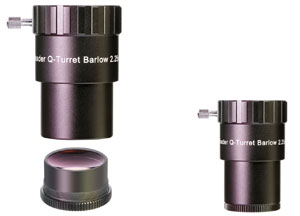
For connecting cameras to a telescope, a Barlow lens or better a telecentric lens (e.g. TZ-3 / TZ-4S) is usually used to achieve the desired magnification or focal ratio. However, many Barlows do not have a connection thread on the camera side, as they are intended for use with eyepieces or lightweight planetary cameras. A heavy camera would then have to be held in place by a simple 1.25" eyepiece clamp – perhaps even only with a simple screw, without a clamping brass ring. Instead of resorting to a more expensive Barlow with adapter threads – or even to our FFC – Fluorite Flatfield Converter (3x-8x Barlow Lens) (#2458200 , € 730,- ) , which was originally designed for 6x9 cm medium format – many customers remember the old method of eyepiece projection and want to use their existing, high-quality wide-angle eyepieces for it. Today, high-end wide-angle eyepieces provide a similar sharpness and performance for projection purposes that was once reserved for ortho-eyepieces.
That's why our Hyperion- and Morpheus-eyepieces are equipped with an M43-thread. A sturdy adaptation to the T-2-standard is possible with the Adapter M43i to T-2a – for Hyperion® / Morpheus eyepieces (#2958080 , € 19,- ) , so that even heavy cameras can be attached to eyepiece and camera without tilting. This is a feature which many other manufacturers do not offer.
For smaller eyepieces with outer diameters of up to 38 mm, our OPFA-system (
 OPFA - Eyepiece Projection adapter (I - VII)
(various versions available)
) is the perfect tool. But they are – just as the projection adapters by other manufacturers – limited to smaller eyepieces and are too small for larger modern wide-angle eyepieces.
The M68-system for heavy loads
We would like to show you two larger adapter families which let you use larger eyepieces for eyepiece projection, too: M54 und M68.

The M68-System offers an inner diameter of 62 mm and was used for the large Zeiss-telescopes. It has proven its worth for attaching even very heavy accessories without tilting to the telescope. It is the perfect solution for all telescopes which already provide a thread at the focuser. The M68 Telecompendium for telecentric systems and FFC (#2459258 , € 440,- ) is a complete set with which you can attach even very heavy instruments – no matter if you want to use large cameras with filter wheel, H-alpha-filters or a spectrograph – at your telescope behind some focal extender lens, without putting the load to that focal extender.
The M54-System for medium-size Telescopes
For medium-sized telescopes where the M68 system would be ‘overkill’, we offer the M54-System, which is light enough to be carried by a 2’ eyepiece clamp. Of course, it is also possible to screw it to suitable focusers or accessories - for example with our UFC filter drawer via the adapter UFC Camera-Adapter M54a – Optical height: 2mm (#2459117 , € 32,- ) , or to our Steeltrack focusers using the adapters Adapter M68a to M54a (#2458230 , € 53,- ) and Adapter S58-short to M68a – for all BDS Diamond Steeltrack® (#2957206 , € 39,- ) .
The M54 thread (M54x0.75, which must not be confused with the M54x1 thread of some Sky-Watcher/Orion telescopes) is increasingly used on focusers, but also on many astronomical cameras, e.g. from Atik, ASA or QHY. It avoids vignetting on large camera sensors and is stable enough not to bend even with heavy weights. We offer M54 extension tubes in various lengths, as well as a M54-Tilter and the UFC filter drawer to eliminate any tilt in the system.
The right Setup for each Purpose
A customised adapter for eyepiece projection can easily be assembled using these adapter systems. The basic structure is always as follows:

- Optional: Adaptation to the connection thread of the telescope (not necessary if you use a 2" eyepiece clamp):
- For Schmidt-Cassegrain: Adapter 2"/SCTi to T-2a – rotatable (#2958500B , € 51,- ) For Zeiss M44 adapter thread: Adapter M44a to T-2a (#1508005 , € 51,- )
- For M43 thread, e.g. Vixen: Adapter M43x1a to T-2a (#1508037 , € 33,- )
- 2" to 1¼" Reducer – with 2" filter thread (#2408190 , € 46,- ) , is also used as nosepiece for 2" eyepiece clamps
- Adapter to M54:
- Adapter M48a to T-2i (#2458110 , € 22,- ) and
- Adapter M54a to M48i (#2958751 , € 36,- )
- M54 extensions to achieve the desired spacings, e.g. M54 Extension Tube – 40 mm (#2958740 , € 39,- )
- Adapter M54i to M48a (#2958750 , € 36,- )
- Camera-adapter with M48-thread, e.g. a Baader Wide-T-Ring. Depending on the model, an additional Adapter S52a to M48i (#2958552 , € 25,- ) may be necesssary.
We currently do not offer a direct adaptation to T-2, as the T-2 thread can cause vignetting on larger sensors. Full-frame M48 camera adapters are usually used mainly for M54 adaptations, anyway.
The number and length of the extension tubes required depends on both the overall length of the eyepiece and the desired magnification. The magnification depends on the focal length of the eyepiece (fOk) and the projection distance (a). The equivalent focal length is calculated as follows (the longer it is, the larger the image on the sensor):
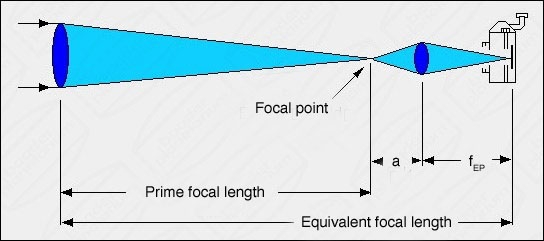
It is easy to see from the formula: If you reduce the focal length of the eyepiece and/or increase the distance a (between eyepiece and camera sensor), the equivalent focal length (i.e. the magnification) increases; the image becomes larger. In this way, very high equivalent focal lengths can be achieved easily.
You can also use Barlow lenses this way - please refer to our two blog posts below for the correct distances. This means that both wide-angle eyepieces and Barlow lenses without connection threads can also be combined with the heaviest accessories - light-tight and without the risk of tilting!
 Barlow lenses, their magnification factors and working distances 17. October 2022 - Learn how different Barlow lenses can affect magnification. From the VIP Barlow to the Hyperion Zoom Barlow lens. Weiter lesen