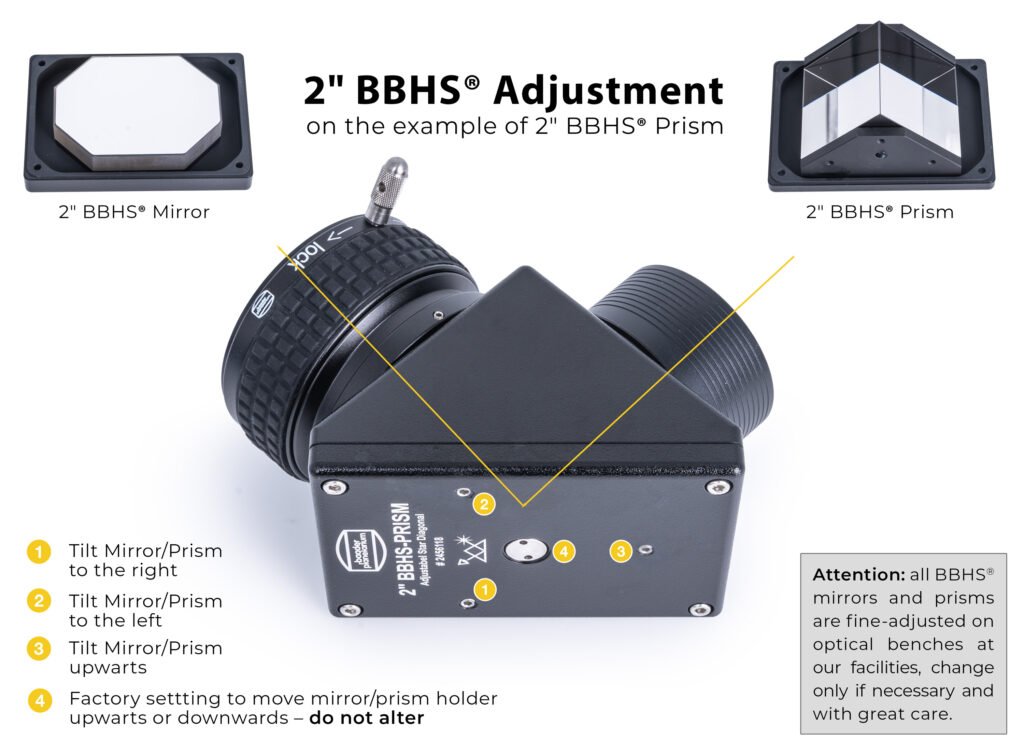

Factory Setup and Benefits
All 2“ BBHS Prism and Mirrors are mounted with high-quality optical glue – free of strain – on individual support structures within an enclosed housing. This method of supporting the optical components allows the optics to be adjustable within the optical light path. With the new 3-point adjustment system, every 2" BBHS® Mirror and Prism's optical and mechanical axis is perfectly aligned in our factory.
This offers three main advantages in addition to the unmatched performance of the BBHS Star Diagonals:
- Uncompromising optical adjustment for highest demands of optical precision.
- Flexibility for users whose systems present issues that normal diagonals cannot resolve
- Ability to build fully adjustable systems for users who, for example, want to build a Bino Telescope System

Alignment and Modification
The 3-point alignment is set in our factory so that the image shows no noticeable rotation around its center when the diagonal is turned 180° in a properly aligned eyepiece clamp. Optical and mechanical axes are matched perfectly on our optical benches.
If you decide to change this setting due to issues in your setup, you are free to do so. Keep in mind, once changed, you will lose the warranty on the alignment of the BBHS® Star Diagonal. The rest of the warranty remains valid.
Adjustment Procedure
Before you try to adjust the diagonal, make sure that any rotation issue is not caused by tilt in the focuser.
To change the alignment, use only the three set screws (1, 2, 3) arranged around the center screw (4). These M3 screws allow careful adjustment, regardless of mirror or prism. The center screw holds the prism and ensures the reflective surface sits exactly in the mechanical axis. Do not alter this screw.
Adjustment is done using a push-and-pull method: loosen one screw and tighten the other two, or vice versa, until the star stays centered when you rotate the diagonal. Once the position is correct, tighten all three screws evenly to avoid losing alignment.
Fastening these small screws must be done gently without the use of force. A proper hex wrench should only need two fingers for tightening. With an Allen key, insert the long side into the screw and use only the long side – never the short side – for tightening to avoid applying too much force.