Home/Accessories/Imaging Accessories/Camera Adapters (T-Rings)/Protective T-Ring Canon EOS to T-2/M48i with 2" Nosepiece
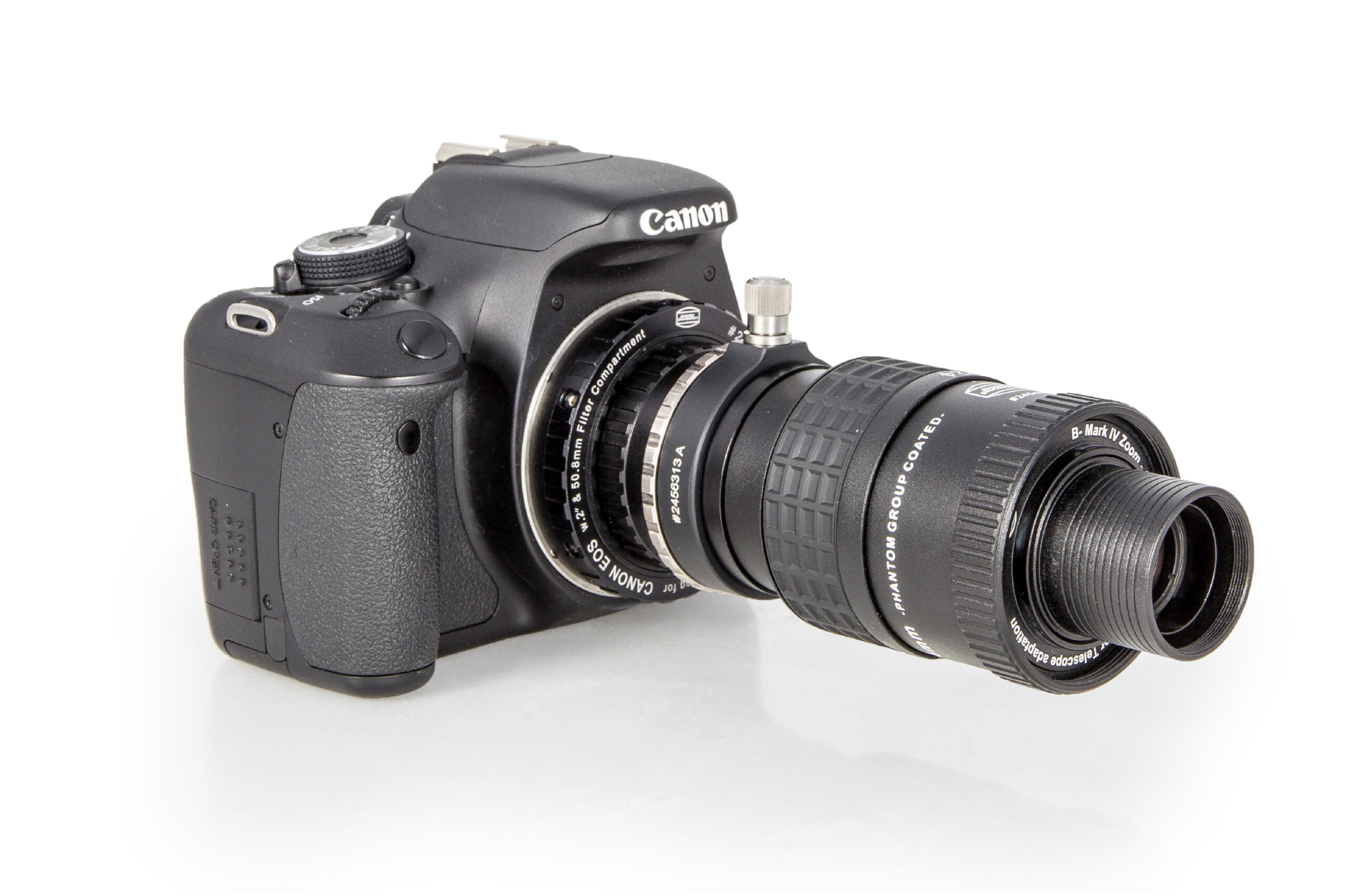
Protective T-Ring Canon EOS to T-2/M48i with 2" Nosepiece
Product Details
- SKU2958550
- EAN Code4047825024718
- ManufacturerBaader Planetarium
Ports & Compatibility
- Clamping SystemDovetail clamp
- Compatible BrandsAstro T-2Baader Planetarium
- Inner Connection (eyepiece/-camera-sided)M48
- Inner Connection (lens sided)M42 x 0.75 (T-2)M48S52
- Outer Connection (eyepiece/-camera-sided)S52
- Outer Connection (lens sided)ø 2" (50.8mm)
- Screw Type6x M1,3 Allen wrench screws
Dimensions & Weight
- Inner Diameter / Clear Aperture (mm)41
- Net weight (kg)0.06
- Outer Diameter64
Optical & Usage Specifications
- Optical length (mm)12
- Type of AdapterCamera AdapterFilter holderReducing Adapter
- UsageProtects the camera body against dust and humidity
Recommended Blogposts
Customer Reviews
5.0
100%of customers recommend this product
Tell us what you think about this item!
Top customer reviews
Michael Luy
I recommend this product
Rating
Was this review helpful?00
Die Steckhülse ist sehr robust und fein gearbeitet. Sichere Aufnahme der Kamera auch bei stundenlange Belichtung.
Gute Verarbeitung
Franz Klauser
Rating
Was this review helpful?00
Bisher hatte ich meine Schmalbandaufnahmen immer mit einer CCD-Kamera und Filterrad an meinen Newton- Teleskopen gemacht. Da ich inzwischen auch einige CANON EOS Kameras im Einsatz habe, war der Wunsch da, die reinen RGB-Aufnahmen mit Schmalbandaufnahmen zu kombinieren.
Für meine EOS 6DA suchte ich daher nach einer Alternative zu den Clipfiltern und wurde mit BAADERs speziellem T-Ring fündig. Die Möglichkeit, sowohl ungefasste als auch gefasste Filter einlegen bzw. einschrauben zu können, ist genial. Als Ergebnis lege ich eine Bild vom mittleren und rechten Teil des Zirrusnebels bei. In den Ring wurde für Schmalband der L-eXtreme Filter eingelegt.
Die finale Bildbearbeitung wurde von Manfred Wasshuber durchgeführt
die Möglichkeiten
---
Andreas Schuster
Rating
Was this review helpful?00
Ich verwende ein Maksutov-Teleskop mit 1500 mm Brennweite ausschliesslich für besondere Situationen in der Naturfotografie. Bestimmte Vogelarten sind extrem scheu und haben eine große Fluchtdistanz, zum Beispiel Kiebitze oder Greifvögel. Für Vögel im Flug ist diese Ausrüstung nicht geeignet, aber von Vögeln auf Ansitzen oder an ihrer Futterquelle kann man ausreichend große Fotos schießen und damit genügend Details auf das Bild bekommen. Verwendet man für den Kamera-Anschluss einen "normalen" T-Ring, verstaubt der Kamerasensor in regelmäßigen Abständen. Daher verwende ich lieber den T-Ring mit Klarglasfilter, um die Kamera mit dem Teleskop zu verbinden. Kleiner Wermutstropfen ist, dass man den inneren Ring nicht wie beschrieben an den Einkerbungen vom äußeren Ring abschrauben kann. Man muss stattdessen die äu0eren Schrauben lösen. Da sollte die mitgelieferte Beschreibung bitte aktualisiert werden.
Wir bitten um Entschuldigung, dass Sie hier wohl ein Exemplar erhalten haben, bei welchem die Madenschrauben wohl etwas zu fest voreingestellt waren, sodass sich der M48 / T-2 Ring nicht wie beschrieben von Hand lösen ließ. Wir haben dies gerade bei einem Musterexemplar ausprobiert, da hat es hervorragend geklappt. Wir werden hier bei der Endmontage noch vermehrt darauf acht geben, dass so etwas möglichst nicht mehr vorkommt.
Frank
I recommend this product
Rating
Was this review helpful?20
Tolles Zubehör, wie von Baader Planetarium gewohnt, sehr hochwertig. Versuche gerne auch mal Fotos mit einer Canon EOS 500D an meinem 200/1200 Dobson und mangels ordentlicher Nachführung bietet sich der Mond hier immer schön an. Bin ein großer Fan der Baader Hyperion Okulare bin, die sich dank Gewinde unter der Augenmuschel hervorragend für meine Foto-Experimente eigenen. Da ich dann schon häufiger gerne mal das Okular tausche, wollte ich meiner Kamera was Gutes tun und habe mit dem Protective T-Ring und einem zusätzlichen Baader 2" Moon & Skyglow Filter zwei Fliegen mit einer Klappe geschlagen: Das Innenleben meiner Kamera ist beim Okularwechsel nun dank Filter im Protective T-Ring geschützt und der Filter sorgt dann auch gleich noch für eine deutlich "stimmungsvollere Atmosphäre" wie ich finde.
Anbei neben dem Bild mit dem Protective T-Ring mit dem von mir eingeschraubten Baader Moon & Skyglow-Filter auch ein Mond-Foto, das hiermit am 31.05.2020 geschossen wurde...allerdings mit einer Canon-R die an diesem Tag glücklicher Weise zur Verfügung stand. Ob das Bild nun (astro-)fotografisch besonders gut ist oder nicht, darf jeder für sich selbst entscheiden, aber mir gefällt es, insbesondere aufgrund der Wirkung des Filters und des damit erhöhten Kontrasts unglaublich gut :-)
hochwertige Verarbeitung; gute und klare Erläuterung (Filtereinbau); Schutzkappen für beide Seiten inklusive
Johnson
Rating
Was this review helpful?10
Der Protective Canon DSLR T-Ring ist schnell und einfach zum zusammenbauen. Die Filter kann man auch schnell und einfach ein bzw ausbauen.
Ich kann das Produkt wärmstens empfehlen. Echt klasse. Bin begeistert.
I'm questioning the "built-in" optical length extension from a normal T-ring. In Bryan F's question from July 10, 2020 he mentions correctly that the T-ring is effectively extending the backfocus to roughly 56mm instead of the standard 55mm. For a 3mm filter this would be correct. But many filters these days are only about 2mm thick. This results in your T-ring being about 0.3 to 0.4mm too long. Not great for fast optical systems. I'm wondering why the decision was made to make this adapter thicker than the standard T-ring instead of just having the user provide a thin spacer ring to achieve the correct backfocus? You can always add a little spacing, but you can't take it away. For those of us with a filter thinner than 3mm, this system doesn't work very well unless we take a belt sander and file it down a bit. Do you have a solution for this?
Brett Nickeson / July 12, 20221 Answer
- You are right, this T-Ring (which is on the market already for ~10 years) was designed for filters with 3mm filter thickness. We sell it also in bundles with our unmounted 50,4mm (3mm thick) filters. Unfortunately we have no solution for users of such large filters that are only 2mm thin. However, this product has been a big success over the years and we sold many of them, so there never was a need to redesign it.Baader Web Team / July 12, 202220
2
0
Does this T-Ring fit the Canon EOS Full-Frame (RF Mount)?
Pedro Lelis / November 19, 20211 Answer
- Unfortunately, Canon introduced a new bayonet system for the RF-series, so that the Protective T-Ring will not fit - just like all lenses with EF-bayonet. But there are adapters which let you use the standard EOS-lenses with R-cameras, too. You photo dealer should be able to help you.Baader Web Team / November 22, 202110
2
0
Any chance you will be making one of these adapters that will work with the Canon EOS M (EF-M Bayonet)? A few competitors of yours have EOS M to T-2 adapters but having one of these that would fit an EF-M Bayonet with a 2" filter in front that can also connect to your UFC system would be amazing.
Bryan F / July 31, 20201 Answer
- EOS-M cameras are not common in Astrophotography. We would need to produce thousands of adaptors at once in mass production to make it happen, but unfortunately there is no demand for such an adaptor, your inquiry was the first ever.Baader Web Team / July 31, 202050
2
0
Looking at the Protective T-Ring with filter chamber, it does not look like there is much room to grip and thread in a 2" threaded filter. Is there some tool available to insert and remove the filters like the pin type face wrench? If not how does someone insert and remove a 2" filter without touching the lens in such a small space?
Also, now that there are five different Canon EOS R camera models released, do you have any plans to make a version of this Protective T-ring with filter chamber that can directly connect to the Canon R Bayonet?
Bryan F / July 10, 20201 Answer
- There is no special tool. Most filters don't have a completely smooth filter cell, but provide some kind of grip, which is enough so screw them into the filter thread and to remove them again - you don't have to screw them in with force, just hand-tight. Usually, this thread is used to permanently mount 2"-filters in the T-ring. If you want to change the filter on a regular bases, you better use the 2" filter thread in the nosepiece. At the moment, we are not working on a Protective T-ring for other cameras, but all our nosepieces (for Wide T-rings as well as for standard T-rings or SC-thread) do have a 2" filter thread, so you can mount a 2" filter permanently in the nosepiece and protect it with the included dust-caps of the nosepiece, when it is not in use, without removing the filter.Baader Web Team / July 13, 202030
4
0
In another question you answered that the optical length of the Protective T-ring with filter chamber is actually 11,8mm and not the 12mm listed in the product specifications. Which value is correct?
Also, when using the Protective T-ring on a classic Canon EOS DSLR (44mm optical length) or with a new mirror-less Cannon R with their EF-EOS R adapter (20mm + 24mm optical length), this would put the total optical length at 55,8mm or 56mm.
Considering a Baader 2mm filter, we would then want to add 0,6mm to the total optical length to compensate for the extra focal length caused by refraction through the filter. This would then mean the proper optical length should be 55,6mm with a filter installed.
Based on the stated 11,8mm or 12mm optical length, that means the optical length would include an extra 0,2mm or 0,4mm in optical length respectively.
Will this difference in optical length have an impact? I ask because in another question I asked about the UFC system you suggested fine tuning spacers to get to exactly 55,6mm optical length when using the UFC system with a 2mm filter.
Bryan F / July 10, 20201 Answer
- 11.8mm should be correct, although this is already in a region where the production tolerances of all parts in your setup add up. If this is a problem depends on the f-ratio of your telescope. Fast systems have got only a very small region where the image is sharp, while slower optics are sharp over a larger distance. Also, many optical acessories work with some tolerances. Our MPCC coma corrector e.g. gives the ideal working distance with +/- 1mm tolerance, a Celestron EdgeHD with +/- 0.5 mm for perfect seeing conditions.Baader Web Team / July 13, 202030
2
0
I work with a Cambo x2 pro system mounted on my Canon 5ds.
Now i want to experiment with UV photography so i bought a SCHNEIDER-KREUZNACH COMPONON 60mm f/5.6 ENLARGER LENS which fits on my cambo x2 pro system. I'm not sure where to place the uv-filter, in front of my lens or is it better to place it in front of my body? For example: if i buy a Baader zero-tolerance protective Canon DSLR T-Ring T-2/M48 and 2" and put a 2" UV filter in there, does my EF mount cambo fit on the T-Ring or do i have to buy another adapter to do so? I'm a bit lost, can someone help me out? Thanks
Pim Leenen / February 26, 20201 Answer

- Der Protective T-Ring hat eine Baulänge von 12mm und ist inclusive Filter (die optisch wirkasame Baulänge verlängert sich, wenn ein Filter in den Strahlengang eingebracht wird, abhängig von der Dicke des Filters) etwas länger als ein Standard T-Ring. Wir kennen das Combo-System nicht - es ist schwer zu sagen, ob genug Platz vorhanden ist und dann noch der Fokus erreicht wird. Komplett unvorhersagbar ist es, ob durch eine verkippte Linse irgendwelche störenden Reflexionen zwischen Filter und Objektiv auftreten. Zwischen Kamera und Filter ist das kein Problem, und wenn es Reflexe zum Objektiv gibt, sollten sie eigentlich zur Seite hinausgespiegelt werden - falls sie dort nicht auf irgendwelche reflektierenden Flächen im Objektiv treffen. Das müsste ma wirklich ausprobieren... Einfacher wäre es wohl, wenn Sie den Filter vor das Objektiv setzen. Wenn es ein Filtergewinde hat, benötigen Sie dazu den 2" Filterhalter M48 auf SP54 für (D)SLR # 2408166 Dann steht Ihnen das SP54-Systemgewinde zur Verfügung, und Sie können mit den Hyperion DT-Ringen https://www.baader-planetarium.com/de/zubehoer/adapter-foto-zubehoer/kameraadapter/dt-ringe.html auf die gängigen Filtergewinde von Kameras (oder andere Step-Up/Down-Ringe) adaptieren. Nachteil dieser Adaption: Der Filter sitzt vor dem Objektiv und kann bei Weitwinkel vignettieren. Dafür sind Reflexionen und Abstände kein Problem.Baader Web Team / February 26, 202010
3
0
