Baader Planetarium

Off-Axis Guider for Baader FlipMirror II (BFM-OAG)

In Stock

# 2956951
€122.00

Price excl. German VAT tax (19%): € 102.52

  • Off Axis Guider (BFM-OAG) for direct connection to the FlipMirror II (BFM II) Star Diagonal (#2458055 , € 228,- )
  • This is the only prism that can be tuned to actively center a star on the guiding chip.
  • Use the BFM-OAG to attach an autoguider camera to a Baader FlipMirror II Mirror Diagonal that works with every position of the mirror.
  • The distance between the optical axis and the center of the OAG prism is 17.5mm - once the 4mm spacer ring is removed. This distance provides the largest possible vignetting-free field while retaining all the advantages of the large and movable prism.
  • With one or two DT-4 nosepiece extensions #1905130 you can place virtually any camera above the Off-Axis-Guider so that it is parfocal with the recording camera.
  • The BFM-OAG is also part of the Off Axis Guider for RCC (RCC-OAG) #2956950
  • Requires 24mm back focus on BFM II
Read more

Off Axis Guider for Baader FlipMirror II (BFM-OAG)

Mach1GTO

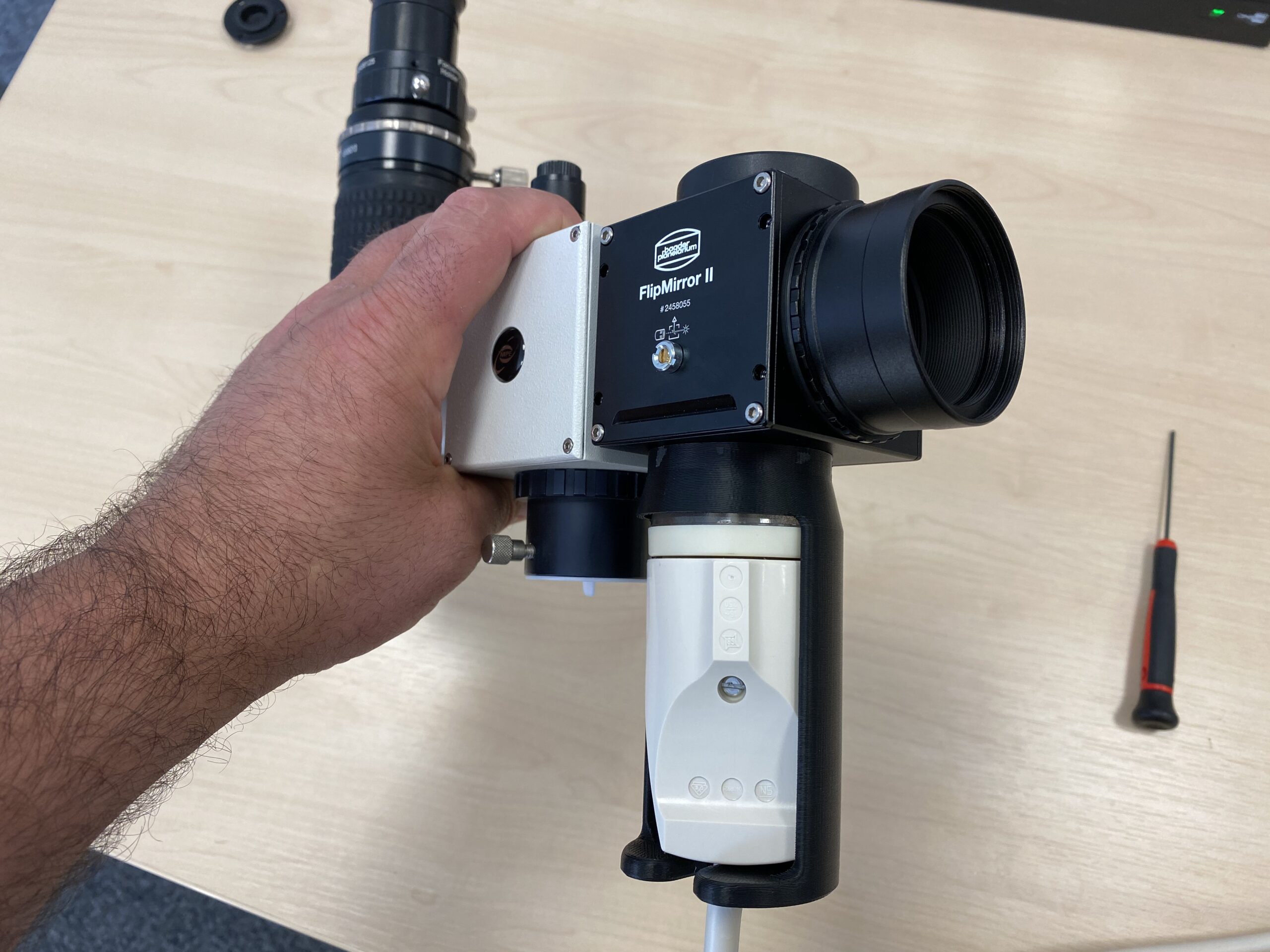
This Off-Axis-Guider is made for the Baader FlipMirror II (BFM II) Mirror Diagonal #2458055. It connects to the bottom port of the BFM II (19 mm nosepiece) and sends light through a pickup-prism to an autoguider camera, independent of the position of the mirror. To attach the Off-Axis-Guider instead to a telescope without BFM II, you need the Off Axis Guider for RCC (RCC-OAG) # 2956950 with T-2-threads.

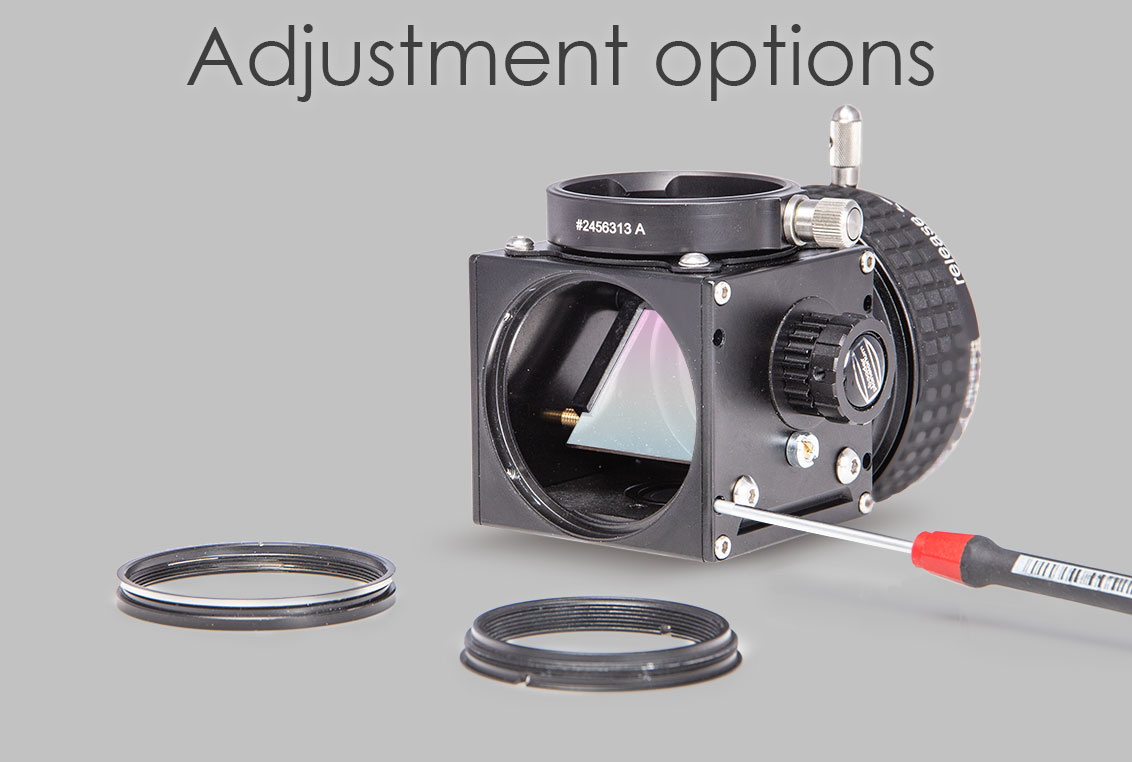
You can attach the Off-Axis-Guider for Baader FlipMirror II (BFM-OAG) directly to the Baader FlipMirror II Mirror Diagonal. You only have to remove the small spacer ring which is included as shown in the image to the left, so that the prism is fully inserted into the light path of the BFM II.

The distance between the optical axis and the center of the OAG prism is 17.5mm - once the 4mm spacer ring is removed. This distance provides the largest possible vignetting-free field while retaining all the advantages of the large and movable prism. This information is important, among other things, to be able to estimate or avoid vignetting of the camera sensor.

If the prism would protrude too far into the light path, the 4mm spacer ring can be inserted. However, this reduces the usable area of the prism, and thus also the amount of light that can be used for tracking.

Please note: this is the only prism that can be tuned to actively center a star on the guiding chip. The vertical side of the prism must face the telescope.

The BFM-OAG is also part of the Off Axis Guider for RCC (RCC-OAG) # 2956950. To use this item with the BFM II, you need to remove the unit with the pick-up prism from the T-2-ring and the spacer ring from the pick-up prism exactly as with the Off-Axis-Guider for BFM II.

Off-Axis-Guider unten am BFM II. Das Prisma schaut immer unter dem Spiegel hindurch.
The Off-Axis-Guider mounted under the BFM II. The prism is visible in the housing, under the mirror.

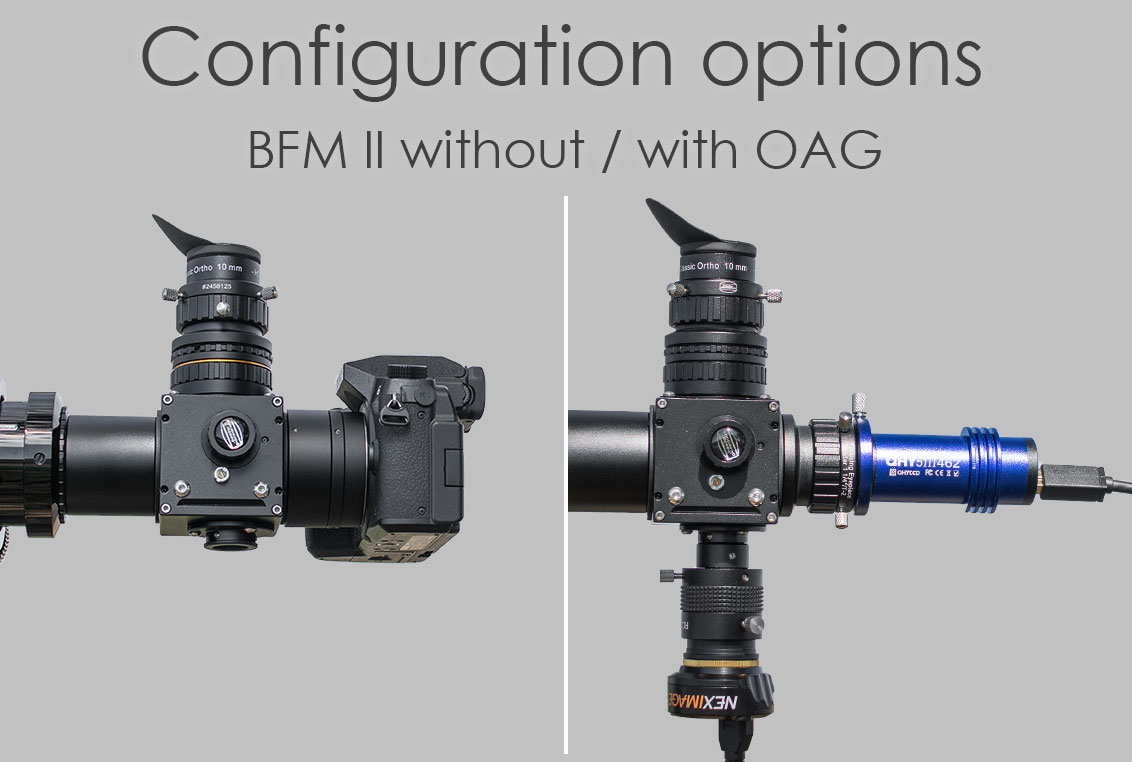
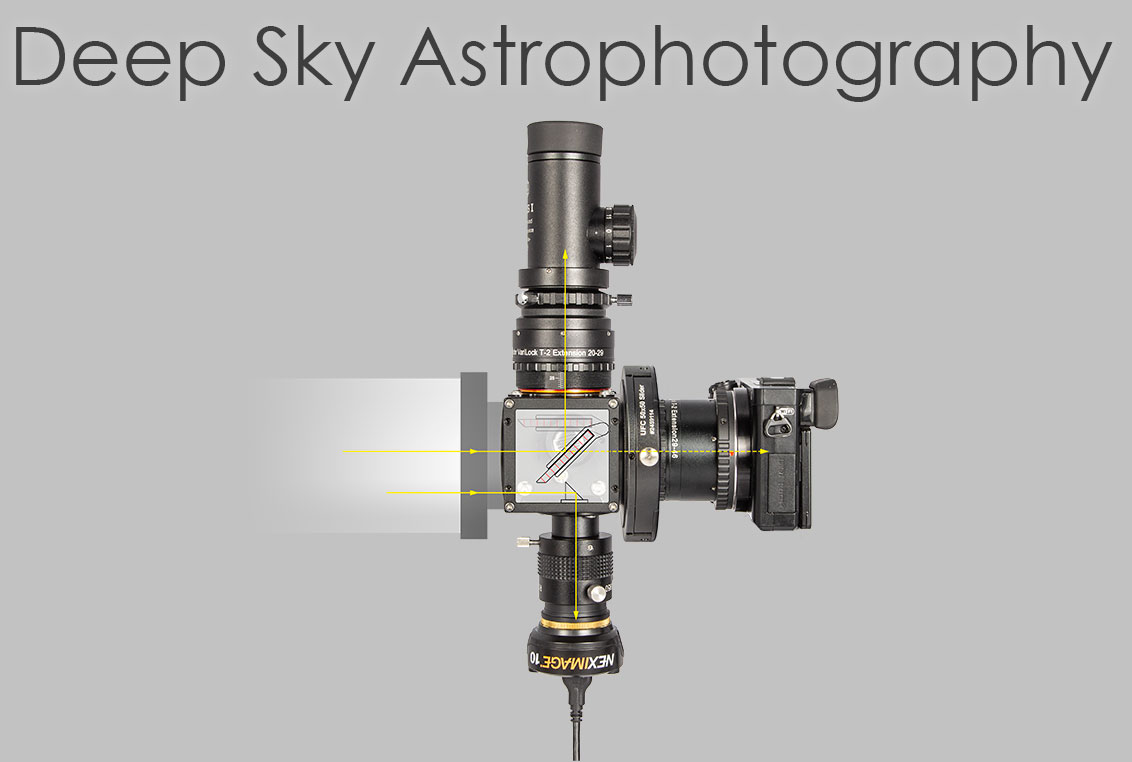
The prism is always below the mirror so that it can also be used when the mirror is down, e.g. to guide a planetary camera connected to the upper port. When the mirror is up, the camera at the rear port should be aligned in such a way that the prism is under the long side of the sensor.

You have several options to set the guiding camera to the same focus plane as the cameras/eyepieces which are connected to main light path of the FlipMirror. You can use the usual combinations of T-2 or M48 extensions tubes to change the position of camera/eyepieces. If you need to bring the autoguider further away from the BFM II, you can extend the 1¼" nosepiece of your autoguider with one or two DT-4-nosepiece extensions #1905130 and lock the position with the Focusing Ring Collar FR-4 #1905131.

If you are using an Off-Axis Guider, you must also consider the focus position of the guiding camera. If you use the Off-Axis-Guider for Baader FlipMirror II as well as a guiding camera whose image plane is at the upper end of the Off-Axis-Guider (i.e. without additional back focus), the image plane of the camera and eyepiece is about 24mm behind the two T-2 threads of the BFM II. A CCD camera with a short back focus, for example, can be adjusted to this distance with a VariLock 29, as can the Polaris I crosshair eyepiece when connected directly to the VariLock 29 via T-2. Thus, a very short adaptation is possible.

If you use a DSLR via a T-2 adapter, or an eyepiece clamp for the eyepiece, you need more back focus. Then, the guiding camera must be placed at a greater distance from the BFM II. The easiest way to do this is to use the DT-4 nosepiece extension #1905130 with an overall length of 18.5mm. It has the diameter of "1¼" eyepieces and is screwed into the "1¼" filter thread of the guiding camera. With one or two of these extensions, you can place virtually any camera over the off-axis guide so that it is parfocal with the recording camera.

Show more

Off-Axis Guider for Baader FlipMirror II (BFM-OAG)

  • SKU
    2956951
  • EAN Code
    4047825041395
  • Manufacturer
    Baader Planetarium
  • Net weight (kg)
    0.07
  • Optical Design
    Guider
  • Optical length (mm)
    43mm + 3,5mm Extension tube (requires 24mm Back focus on BFM II)
  • Outer Connection (lens sided)
    ø 1¼" (31.75 mm)
  • Prisms Width
    9.5 mm

Customer Reviews

4.0
reviews
Tell us what you think about this item!

Top customer reviews

Kelly H
I recommend this product
Rating
00
Works, but….
The OAG does work great when you’re able to get stars into view, but there does seem to be too much light coming through somewhere getting to the sensor. Could be the flip mirror box itself though or the eye piece area. . I would also recommend adding another set screw to help hold the prism base to the mounting base of the OAG. No matter how hard I tighten it, it still moves too easily with a little pressure.
Baader Planetarium
Response from Baader Planetarium
The situation regarding the OAG is currently new to us and we have not been able to reproduce this behavior ourselves. Should you be able to describe the problem in more detail, this could make it easier to find a possible solution; assuming the issue has not already been resolved in the meantime? The reflections you mentioned may originate from the rear side of the mirror assembly, depending on the specific setup and angle of incoming light. With a bit of DIY effort, you can cover the rear side with black cardboard or black paper material (Ideally black-painted sandpaper, like the description provided below), as shown in the attached images from a customer. He was so kind to share the following additional information in the review section: I tested the following solutions to cover the back of the mirror: 1. Black printed paper or black photo book paper. This doesn't work very well. Light rays that run almost parallel to the tube surface are still well reflected. 2. Good optical black paint on the paper back. This helps a lot, but the reflections are still there. 3. Optical black painted sandpaper. This works well. Photo: „ReflexSolution 01 and 02“ The cover plate is 30 mm wide and 31 mm long. Additional folded edges, 3 mm at 45 degrees at the front and 4 mm at 90 degrees at the rear, increase rigidity, help positioning and prevent reflections on the leading edge. With 2 strips of double-sided adhesive tape of 2–3 mm width, this cover plate can be fixed without damaging the original rear mirror. Prior to assembly I made the cap from No. 60 sandpaper, which was then painted black with slightly diluted Sennelier Mars Black No. 759 Matt.
Show more
Guides great when stars are in view.
Prism base is to loose with only one set screw and too much light getting through.
Andreas Corente
Rating
30
Baader FlipMirror II nun komplett mit dem Off Axis Guider
Gutes Produkt und es wird mit die Möglichkeit geben meinen Leitrohr wieder als Sucher bzw. für Großfeldfotografie zu nutzen. Leider passt bei mir nur ein Okularguider. Da der Fokus relativ kurz ist. Durch ein T2 Gewinde an der Basis des OAG hätte da mann wahrscheinlich mehr Möglichkeiten gehabt in den Fokus zu kommen.
Sehr gute Einstellbarkeit und das optische Finish!
Hätte mit ein T2 Gewinde zusätzlich zur Steckhülse gewünscht!
Ingo Küttner
I recommend this product
Rating
10
Off Axis Guiding mit garantierten Leitsternen
Der Off Axis Guider wurde zusammen mit dem Baader FlipMirror II Zenitspiegel #2458055 bestellt und trägt eine Alccd-QHY 5III 174 Guidingkamera. Die Lösung für das Neigen des Prismas im Gesichtsfeld führte bisher in meiner Praxis immer zu einem Leitstern. In einem Fall lichtete ich mit f/10 einen Asteroiden in einer recht sternarmen Gegend ab. Dank der Verstellung des Prismas hatte ich hier sicher eine Leitstern gefunden! Mit der Adaption des Guiders am Baader FlipMirror II Zenitspiegel hatte ich anfangs ein paar Startschwierigkeiten. Hier hatte ich anfänglich zu vorsichtig die beiden Madenschrauben, die den Guiderport am Flippmirrorarretieren, festgeschraubt. Nach kurzer Zeit bemerkte ich ein Verkippen der Guidingkamera bzw. des ganzen Off Axis Guiders. Hier darf man ruhig die beiden Schrauben sehr straff anziehen. Sonst wird der Guider nicht fest genug sitzen! Hier wäre m. E. eine Gewindelösung der Schnittstelle angebrachter. Funktionell muss ich in meinem Fall keine Abstriche machen! Der Aufbau bleibt zusammenmontiert größtenteils am Teleskop oder wird als Ganzes in einem Koffer verstaut. Wieder montiert bleibt die Justierung erhalten. Alles ist sehr wertig verarbeitet. Ich kann den Guider nur weiter empfehlen. Ach und alle die, die dem Off Axis Guiding skeptisch gegenüberstehen haben jetzt dazu keinen Grund mehr.
Show more
Baader Planetarium
Response from Baader Planetarium
Vielen Dank für Ihre sehr positive Bewertung. Wir verstehen Ihren Einwand, dass ein Gewinde grundsätzlich für eine festere Verbindung sorgen würde. Allerdings ist dies nicht ganz trivial, denn das Gewinde müsste ja dann noch drehbar sein, da man den Anschlagpunkt (Endpunkt) des Gewindes nicht fest definieren kann und somit der Off-Axis Guider evtl. nicht Richtung Teleskop zeigen könnte. Die Stecklösung ist daher aus unserer Sicht die universellere Lösung - und nach Anfangsschwierigkeiten aufgrund zu lockerer Schrauben scheint es für Sie ja auch zu funktionieren.
Die Lösung für das Neigen des Prismas im Gesichtsfeld
98/100 Punkten bekommt die Adaption des Guiders am Baader FlipMirror II Zenitspiegel. Hier wünsche ich mir, dass der Guider in den Flippmirror eingeschraubt werden kann. Das bringt nochmal ein Plus an Stabilität beim Tragen der Guidingkamera.
Off-Axis Guider for Baader FlipMirror II (BFM-OAG)

Choose Files

(jpeg, png)

No file(s) chosen

    No questions yet
    Be the first to ask a question about this product - it will be answered by other customers or an Admin.