Baader FFC – 2" / T-2 Fluorite Flatfield Converter
The CaF2 Fluorite Flatfield Converter is more than just a high-quality Barlow lens. It was created with the goal of producing the best Barlow lens in the world – with a flattened field. It can be used photographically and visually on any optical system. The FFC is still the only Barlow lens with two cemented elements using genuine fluoride (CaF2). It was designed for an image circle with a diameter of 90 mm, for uncompromising sharpness performance in the days of medium-format cameras. Even today, its imaging performance remains unsurpassed and is fully prepared for the demands of modern cameras with small pixels.
The Fluorite Flatfield Converter was designed for the 150/1200 Zeiss APQ apochromat and delivers an absolutely flat image field at f/8. This flat field is retained even at other focal ratios. Even on a fast telescope, the FFC delivers significantly better imaging performance in the center of the field, which is important for planetary photography, than a classic Barlow lens, so that even modern telescopes can only fully exploit their performance in lunar and planetary photography when used with the FFC.
The CaF2 Fluorite-Flatfield-Converter can be combined with every optical system for photography and visual observations as best and most sophisticated barlow lens in the world
- apochromatic, fully multi-coated lenses (note: w. multicoated Fluorite-lens faces
- Resolution in lines is 10x higher than that of the best projection eyepieces
- The only barlow lens with two putty elements using genuine Fluorite (CaF2). Calculated for a 90 mm image circle, for uncompromising sharpness performance in the days of medium format cameras. Still unsurpassed in imaging performance today.
For almost 20 years (as well as 20 years ago already) our customers had asked again and again: "Do you have a barlow lens or projection eyepiece – but with a flat field – which can be used with medium format (6x7 Pentax) cameras for imaging sun, moon and planets, but without the typical loss of sharpness?"
This bothered us back in those times , and finally one of the designers of the Zeiss APQ lenses calculated the ultimate projection system with a flat image field in 1997. To actually make this design become reality, extreme types of glasses were needed. In this case, two multicoated fluorit-lenses - at that time and until today - a nightmare to produce.
The result was an optical system with an unmatched sharpness, with a ten times higher resolution of line pairs than a Zeiss Abbe eyepiece. Even so the days of emulsion film cameras are long gone, this lens system has persisted to be "the sharpest barlow ever made".
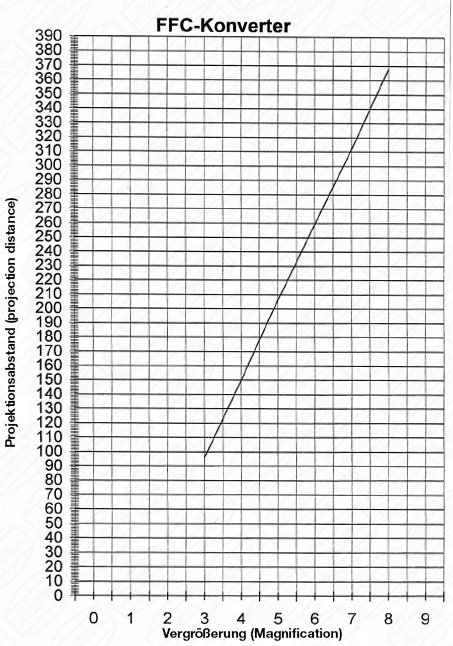
By changing the distance to the camera sensor, you can vary the magnification between 3x and 8x. The optimum line resolution is set at 4x magnification, then you have the full sharpness over an image circle of 90 mm diameter. On the axis, the sharpness is only limited by your telescope – even at a magnification factor of 15x. We have tested this at an AstroPhysics lens telescope. Slowly slowly even the large diffraction limited field of 90 mm will become of importance again - with the advent of ultrafast and giant CMOS-cameras covering a field of 70 mm in diameter.
The FFC can be connected onto every T-2 thread and its 2" main body likewise fits into every 2" eyepiece clamp. With the help of our Astro T2™-System and the M 68-System you can connect it onto a whole world of telescopes.
For best results, you need to keep a certain distance to the original focus point. Please take a look at the PDFs in the Dowmload-section for technical information
Customer statement: The FFC on a Carl Zeiss APQ 130 - Januar 2004
When you are observing and photographing planets, the power and quality of each part in the chain is very important. The result is heavily influenced by design, material, polishing quality of the optical surfaces and the utmost in suppression of straylight. Even small optics can then deliver very good results.
About two years ago I had used the Fluorit-Flatfield-Converter by Baader for the first time ans was positively surprised. I could achieve a better contrast and resolution with the Baader FFC than with normal barlow lenses of good quality.
I use the projection system with up to 8x magnification for taking photos of the planets. This is a rather long setup, and the price seems high, too. But it is well worth the money if you take a look at the build-quality and the achievable results. During the Mars-opposition in 2003 I could take some images with the APQ 130 and the FFC. For such a relatively small telescope, I think they are really pretty good!
Best regards
Dr. Harald Michaelis

How to use CaF2 optical systems. FFC-warning about possible loss of warranty:
The Baader-FFC contains lenses which are made of real Fluorite-crystal. CaF2 has got an impressive refractivity which enables construction of the ultimate lens system that can deliver an incredible amount of sharpness across a very broad spectral range. No other barlow lens design can combine a similar sharpness with such a large image.
Unfortunately, such sophisticated optics are very sensitive to tension caused by temperature differences.
Under no circumstances must CaF2 be exposed to sudden or high changes in temperature. Do not use it for photographing the sun – the fast and high changes in temperature could destroy the Fluorit-lenses. Defects caused by thermal stress can be detected and measured here in house and are explicitly excluded from the warranty.
Also avoid fast changes in temperature during night-observation/imaging. Never use any Fluorite-lenses (especially not in the front lens of a telescope) at -20°C and then all of a sudden put it it into your living room at +20°C or more! In such a case, the resulting severe temperature stress just as well can be detected, when the lenses end up damaged.
Every CaF2 optic needs time to adapt to the surrounding temperature. To do so, for example bring the optical system into the outside in an insulated box and allow it to cool down inside that box over the time of an hour. Keep the box closed but outside. After the imaging session put the FFC back into the same box and allow it to gradually warm up inside that box while bringing it inside the house. Keep it there for at least one hour until you open the box and check that any moisture can dry out.
Please do not use the FFC, if you can not supply the environment and time, to treat this high-end optical system in the way it demands.
The Baader Barlow lenses at a glance
With currently five different barlow lenses in Baader Planetarium's product range, it is not easy to keep track of which model fulfils which function best.
 FFC – Fluorite Flatfield Converter (3x-8x Barlow Lens)
(#2458200 ,
€
730,-
) |
90mm field of view also for medium format cameras - uncompromising quality even for extreme enlargements. Focus gain: depending on configuration about 1.5-2.6cm |
 Barlow Lens Carl Zeiss Abbe 1¼" (2x)
(#1603321 ,
€
477,-
) |
Legendary Zeiss quality for the common magnification range between 2x and 3x (with additional T-2 extensions). With T-2 connection for cameras or eyepiece clamps. The qualitatively equivalent solution to the Fluorite FFC when smaller field size and smaller post-magnification are desired. Focus gain: About 3 cm |
 Barlow Lens VIP, modular , visual and photographic (2x)
(#2406101 ,
€
228,-
) |
Versatile barlow lens for magnifications from 2x, for use with cameras (via T-2 thread) and eyepieces. Calculated for 35mm image diagonal (full format). With additional T-2 extensions it can also be used for slightly higher magnification factors. Focus gain at 2x: Approx. 3.3 cm |
 Barlow Lens Q-Barlow (1.3x / 2.25x)
(#2956185 ,
€
55,-
) |
Inexpensive and amazingly high quality Barlow lens for the lower magnification range: In addition to being used as a normal Barlow lens with eyepiece clamp (with factor 2.25x), the Barlow element can also be used as a negative lens group when screwed directly into (almost) all eyepiece sleeves or directly in front of a camera with 1.25" filter thread and then provides a lower magnification of approximately 1.3x. Ideal for adapting a modern planetary camera to the resolution of an already long focal length telescope. Prerequisite: There must be no other elements in the nose piece that would prevent the approximeately 13 mm long Q-Barlow lens group from being screwed in. Focus gain at 2.25x: About 0.4 cm |
 Barlow Lens Hyperion® Zoom (2.25x )
(#2956180 ,
€
133,-
) |
Specially designed for the Hyperion Zoom eyepiece, also fits the filter thread of other eyepieces.
With the included T-2 adapter, it can also be used directly on cameras; provides about 2.7x at 55mm working distance and about 2.3x at 25mm. Focus gain: About 1.1 cm |
More information, images results...
... can be found on our detailed Blogpost:
FFC – Fluorite Flatfield Converter (3x-8x Barlow Lens)
- SKU2458200
- AR-CoatingHigh transmission multi-coated (HT-MC)
- EAN Code4047825009999
- Inner Connection (lens sided)M42 x 0.75 (T-2)
- Magnification (x)3x - 8x
- ManufacturerBaader Planetarium
- Net weight (kg)0.24
- Optical DesignBarlowField Flattener
- Outer Connection (eyepiece/-camera-sided)M42 x 0.75 (T-2)
- Outer Connection (lens sided)ø 2" (50.8mm)
- SpecialityBarlow lensField Flattener