
C5 Series CMOS Cameras
The C5 camera series is designed to accommodate the latest generation of extremely large Sony IMX CMOS sensors with 100- and 150-megapixel resolution and a diagonal dimension of up to 67 mm. Many of the sensor features are the same as those used in the C3 series, including a pixel size of 3.76µm with a full-well capacity of over 50 ke-, very high quantum efficiency due to the back-illuminated design and very low dark current. C5 sensors also offer 16-bit digitisation, perfectly linear response to light and exceptionally low read noise. Despite the very large sensors, the C5 camera head dimensions are the same as the Enhanced Cooling variants of the C3 and C4 models. All these features make the C5 cameras the ultimate tools for both aesthetic astrophotography and astronomical research.
The C5 cameras are available in two versions:
The asymmetrical version, designated C5A, and the symmetrical version, designated C5S. Both cameras can be equipped with an optional GPS receiver for precise exposure timing. Compared to the C3 and C4 cameras, both the C5A and C5S series feature a completely redesigned air cooling system - more powerful and quieter than even the EC versions of the C3 and C4 models. The supplied AC/DC brick power supply is also more powerful and features a more robust power plug.
The asymmetrical appearance of the C5A variant reveals the same proven design as the C3 and C4 series, both in terms of external shape and internal construction. The front cross-section of the C5A cameras is the same as that of the C3 and C4 series, although the sensors used are much larger. The thickness of the C5 head is the same as that of the Enhanced Cooling versions of the previous models. Asymmetrical models also feature a mechanical shutter, allowing dark or bias frames to be captured without the need to cover the telescope aperture.
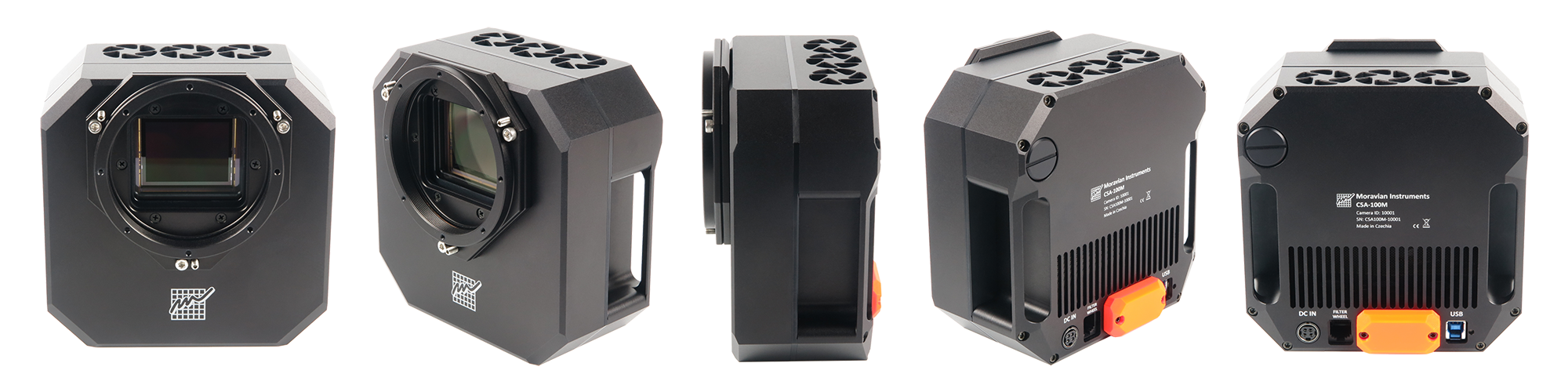
The main purpose of the symmetrical C5S is not to exceed the central obstruction of reflecting telescopes with the camera in the primary focus. The asymmetrical variant typically exceeds the central obstruction of smaller telescopes (with ~0.4m primary mirror diameter), although the central obstruction of wide-field telescopes is quite large.
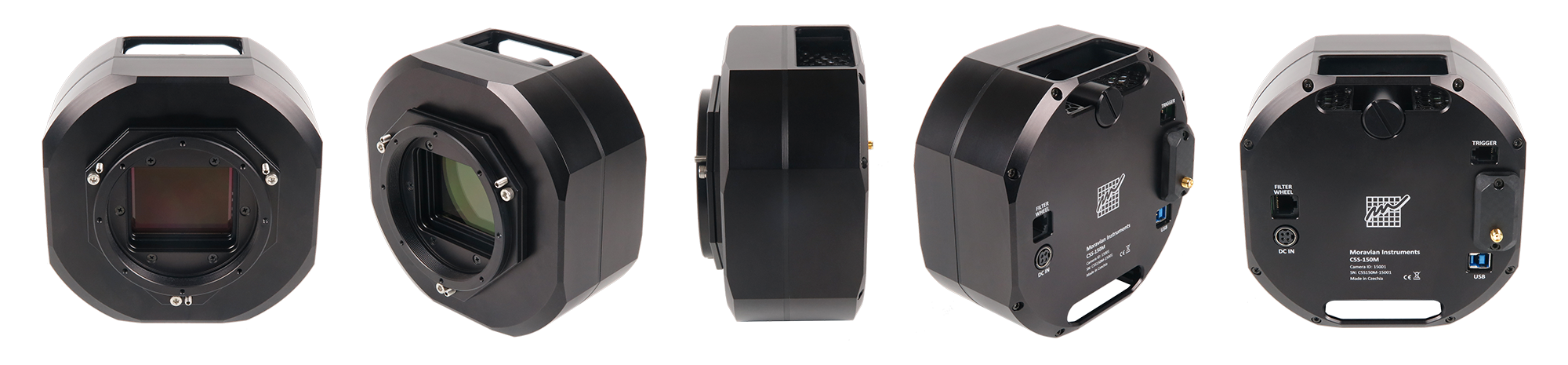
Due to mechanical limitations, the symmetrical model lacks the mechanical shutter.
Asymmetrical and symmetrical model comparison
Feature
100 and 150 MPx sensors
Compatibility with filter wheels
M68 and M85 tiltable adapters
Mechanical shutter
Optional GPS receiver
Hardware trigger input
Asymmetrical C5A
Yes
Yes
Yes
Yes
Yes
No
Symmetrical C5S
Yes
Yes
Yes
No
Yes
Yes
The use of large sensors has required a complete redesign of the camera interface, and the C5 series only offers an M68 × 1 threaded adapter on the smaller 100 Megapixel C5. The large 150 Megapixel C5 version standardises on the M85 × 1 thread on the tilting adapter. As with the C4 series, the internal filter wheel is not an option, external filter wheels are required and the C5 cameras are equipped to control the new EFW-5XL series of filter wheels. Huge sensors require huge 65 × 65 mm square filters, and the EFW-5XL-5 is designed for five such filters. The EFW-5XL-7 filter wheels for seven smaller 50 × 50 mm square filters are available for the 100 Megapixel C5 variant with a smaller sensor.
Rich software and driver support allows C5 cameras to be used without the need to invest in third-party software, thanks to the free SIPS software package supplied. However, ASCOM (for Windows) and INDI (for Linux) drivers and Linux driver libraries are shipped with the camera, providing the ability to integrate the C5 camera with a wide variety of camera control programs.
C5 cameras are designed to work in conjunction with a host personal computer (PC). Unlike digital still cameras, which can be operated independently of a computer, scientific cameras usually require a computer for operation control, image download, processing and storage, etc.
The camera must be connected to an optical system (e.g. the telescope) to capture images. Since the C5 cameras have very large sensors with a diagonal of 67 mm (150 megapixel version) and 55 mm (100 megapixel version), the optical system must be able to cover such a large field of view. The camera is designed for the long exposures needed to capture the light from faint objects. If you plan to use the camera with a telescope, make sure that the entire telescope/mount setup is capable of tracking the target object smoothly during long exposures.
Please visit the manufacturer's official website for more detailed information about the C5 CMOS camera series from Moravian
Moravian C5 Series CMOS Cameras
- Technical data not yet specifiedPlease choose product variant from dropdown above to see technical data of your chosen product