WHAPOS — White Aperture Pupil Optical Spectrograph
WHAPOS is a commercially available fiber-fed white-pupil Echelle spectrograph developed by Baader Planetarium for research-grade spectroscopy with large aperture telescopes. It is designed for the visual spectral range and for telescopes of 0.5 m aperture and above, where direct-mounted slit spectrographs can become inefficient due to the plate scale and seeing conditions.
The instrument has been developed with three priorities: high optical efficiency, high resolving power and long-term mechanical and thermal stability. This makes WHAPOS suitable for demanding spectroscopic applications in professional observatories, university education, research projects and advanced observatory installations, including radial velocity measurements.
Spectral performance
WHAPOS covers the visual spectral range from 392 nm to 750 nm and reaches a peak resolving power of R = 24,000 to 28,000. The peak efficiency, including the fiber link but excluding the sensor, is guaranteed and certified at ≥ 30% at 532 nm. The optical design is therefore aimed at obtaining high signal-to-noise spectra while maintaining the spectral resolution required for scientific work.
Typical sky apertures are:
| Telescope configuration | Sky aperture |
|---|---|
| Observable Space (PlaneWave) CDK24 at f/6.5 | 2.96 arcsec |
| Observable Space (PlaneWave) CDK1000 at f/6 | 1.8 arcsec |
| 1.5 m telescope at f/8 | 1.2 arcsec |
This makes WHAPOS particularly well suited for telescopes from 0.5 m aperture and above, where efficient coupling of seeing-limited starlight into the spectrograph is essential.
Mechanical and thermal stability
The spectrograph is built on a custom CFRP carbon fiber reinforced polymer breadboard, providing thermal stability comparable to Super Invar. Precision mechanics with flexure adjustments made from aviation-grade materials support long-term alignment stability. Shock and vibration isolation are included to protect the optical system during operation and transport.
For thermal control, WHAPOS uses double thermal insulation enclosures with active thermal stabilization and internal sensors. The thermal stability is specified at < 0.1 °C due to the included liquid cooling system. For installations where the ambient temperature cannot be kept sufficiently constant, or where maximum camera cooling performance is required, the camera can be integrated into a water-cooling loop.
Fiber-fed design for large telescopes
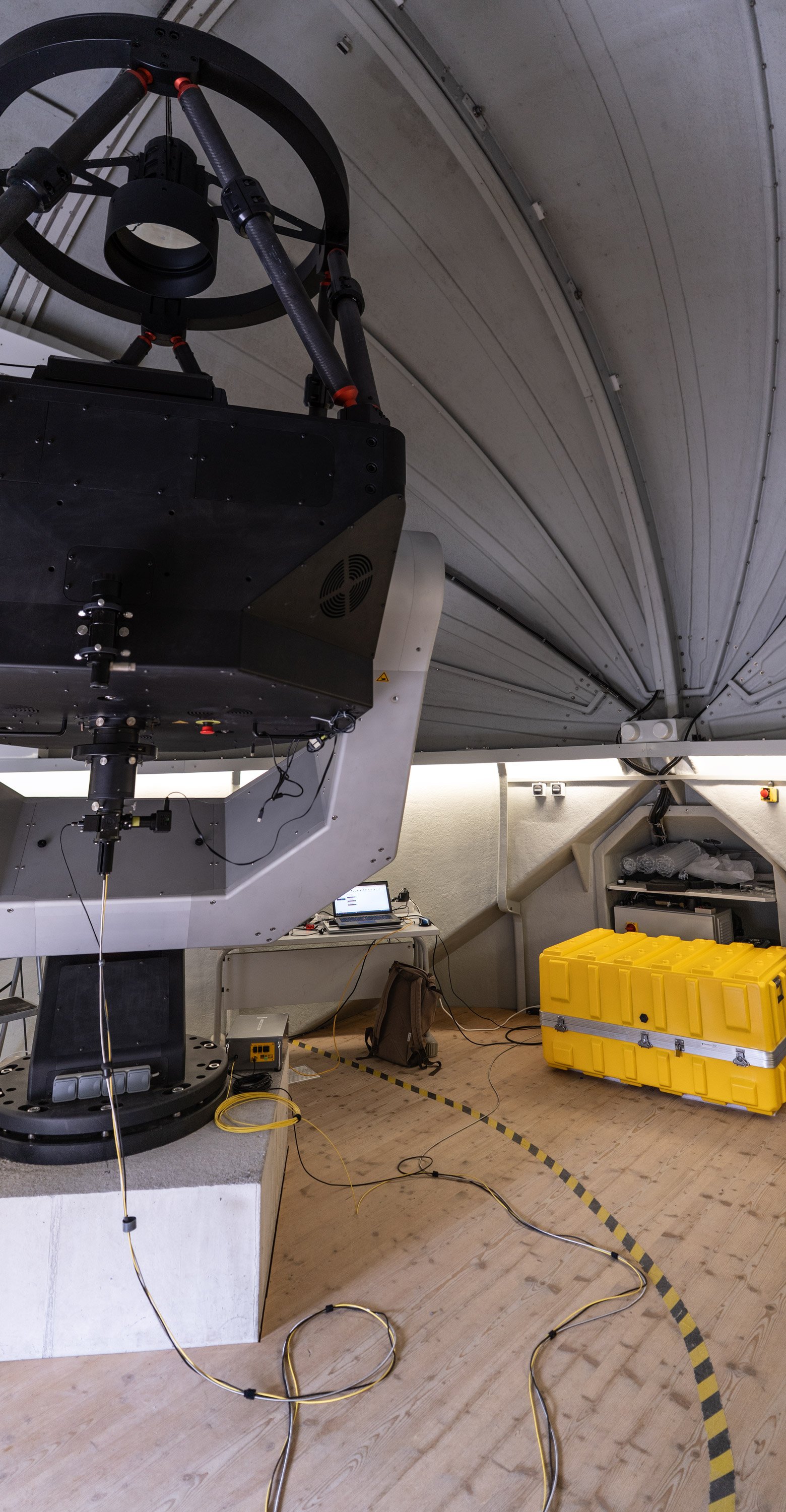
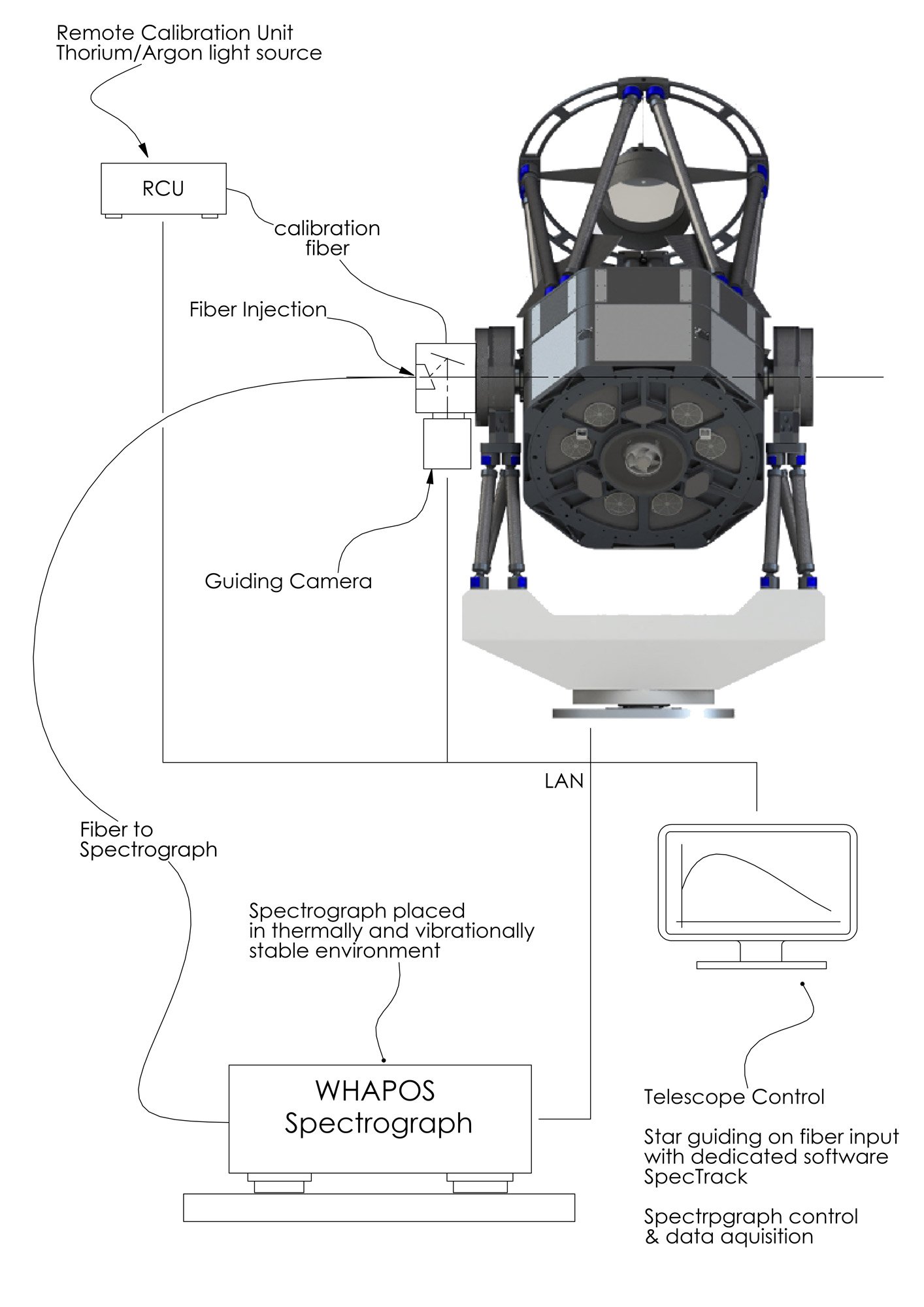
Unlike compact spectrographs that are mounted directly at the telescope, WHAPOS uses a telescope-sided fiber input head and a separate spectrograph ground unit. The telescope interface collects the starlight and feeds it through an optical fiber to the stationary spectrograph. This concept is especially advantageous for large telescopes, where mechanical load, plate scale and environmental stability become critical factors.
The fiber-link adapter is custom adapted to the customer’s telescope. It includes a laser-drilled mirrored glass pinhole plate, dedicated lenses and customer-specific input optics to maximize fiber coupling efficiency. A monitoring camera allows the star to be controlled directly at the fiber input and supports autoguiding on the entrance pinhole. Calibration light can be coupled into the fiber path via a remote-controlled flip mirror.
Calibration and remote operation
WHAPOS requires for operation a RCU (Remote Calibriation Unit) (#2458621 , € 4950,- ) , equipped with Thorium/Argon and Halogen lamps. This allows wavelength calibration and flat-field calibration without manual intervention at the telescope or spectrograph.
A motorized remote-controlled objective is integrated for focusing the spectrum on the detector. This focus adjustment is part of the spectrograph itself and is independent of the telescope focuser. The optical focus on the detector can therefore be optimized remotely without opening the instrument.
A dedicated data calibration and reduction pipeline is included to support the complete observing workflow from acquisition to calibrated spectra.
Versatile Compatibility and Applications
Detector compatibility
The spectrograph is optimized for modern scientific CMOS sensors in the size class of the Gpixel GSENSE 2020 and Sony IMX571. These sensors provide high quantum efficiency in the visual range and are well matched to the WHAPOS optical design.
For turnkey installations, WHAPOS can be supplied with a pre-installed and factory-adjusted scienctific camera and guiding camera. This ensures that the detector position, focus and alignment are already optimized before delivery. Customer-specified cameras may also be used if the available backfocus and mechanical interface are suitable.
Installation concept
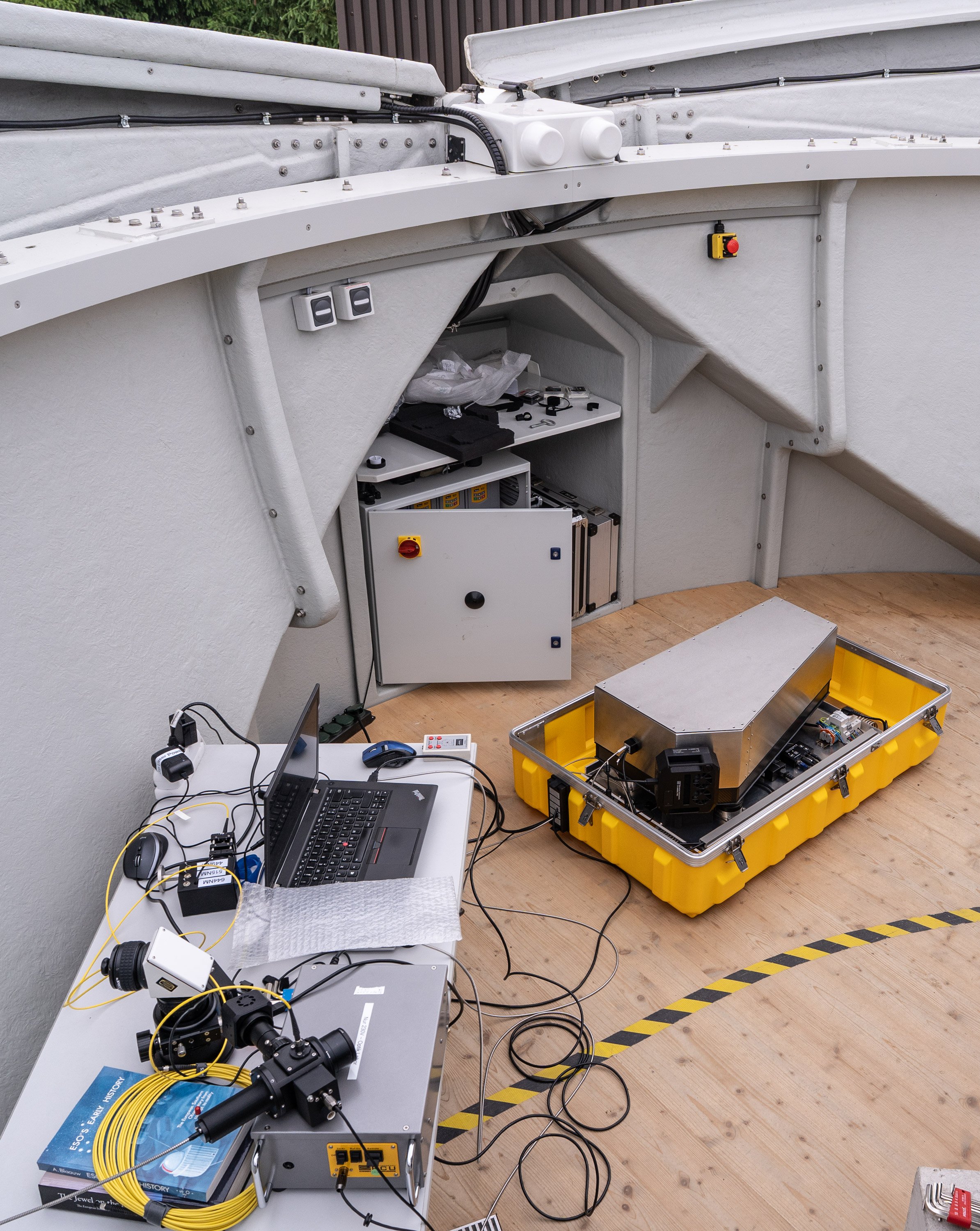
The WHAPOS ground unit is designed as a compact observatory instrument and can be installed in a temperature-controlled room beneath or near the telescope. This keeps the spectrograph mechanically isolated from telescope movement and allows the instrument to operate in a more stable environment.
The complete instrument, including its enclosure, weighs approximately 65 kg. Its compact footprint fits on a standard Euro pallet. The second thermal enclosure also serves as an IP67-rated transport box, making WHAPOS practical to ship, install and commission at observatory sites.
Recommended application
WHAPOS is intended for observatories, universities and research-oriented telescope installations that require a high-resolution Echelle spectrograph with greater input efficiency and stability than a compact telescope-mounted spectrograph can provide on large-aperture instruments.
Typical applications include:
- University teaching and research projects
- Spectroscopic monitoring programs
- Radial velocity measurements
- Young stellar activity, spectral energy distributions and photospheric lines
- Eclipsing binaries and transiting exoplanets
- Follow-up observations of transients, novae, supernovae, flare stars, etc.
WHAPOS is therefore the appropriate choice for customers who require a stable, efficient and remotely operable spectrograph system for large telescopes, rather than a compact direct-mounted spectrograph for smaller observatory setups.
WHAPOS – Fiber-Fed White-Pupil Échelle Spectrograph
- SKU2458700
- Adaptable toGroßteleskope ab 0,5 m Öffnung über kundenspezifischen Faserlink-Adapter; wissenschaftliche CMOS-Kameras mit geeignetem Backfocus
- DimensionsCompact instrument design making it portable and easy to install. Fits on EURO-Palette. Second thermal enclosure also serves as a transport box with IP67 rating.
- Field sizeOptimized for scientific CMOS sensors in the size class of Gpixel GSENSE 2020 and Sony IMX571
- Guiding PortMonitoring/guiding camera at the fiber input for star control and autoguiding
- IlluminationRemote calibration light input via fiber; Remote Calibration Unit with Thorium/Argon and Halogen lamps
- Included AccessoriesWHAPOS Spectrograph with Liquid-cooling system; telescope-side fiber-link adapter with monitoring camera and calibration light input; dedicated calibration/reduction pipeline; thermal/transport enclosure
- ManufacturerBaader Planetarium
- Mechanical DesignFiber-fed white-pupil Echelle spectrograph on a custom CFRP breadboard, with flexure-adjusted precision mechanics, shock/vibration isolation and double thermal enclosure with active thermal stabilization < 0.1 °C
- Optimized for focal ratioCustomer-specific input optics; adapted to the telescope focal ratio via the fiber-link adapter
- Optimized Spectral range392–750 nm
- Optional AccessoriesFactory-installed science camera; alternative customer-specified cameras; IMP85 Instrument Multiport for additional telescope instruments
- Required BackfocusCustomer-specific; defined by the telescope-side fiber-link adapter
- Special FeaturesHigh-efficiency fiber-link adapter with laser-drilled mirrored pinhole plate and monitoring camera; motorized remote detector focus; dedicated data calibration/reduction pipeline; compact IP67 transport enclosure
- Spectral ResolutionPeak resolving power R ≥ 24,000
- UsageProfessional fiber-fed Echelle spectroscopy for observatory and university installations with telescopes of 0.5 m aperture and above. Suitable for high-resolution stellar spectroscopy, radial velocity measurements and spectroscopic monitoring programs