

The purpose of an Energy Rejection Filter is to prevent as much solar energy as possible from entering the telescope in the first place and thus avoid excessive heating of the etalon of an H-alpha filter.
This is done most effectively by a filter in front of the telescope. At the same time, this prevents the air in the tube from heating up - the telescope remains close to the ambient temperature, and there are no air turbulences inside of the OTA due to temperature differences. If we look at the solar spectrum, it becomes clear that such a filter must primarily block visible light. Ideally, it reflects the solar energy energy instead of absorbing it and and does not heat itself up in the process as well - that's why these filters are called Energy Rejection Filters (ERF for short).
Since it is occasionally asked: A Herschel wedge or a white-light front-filter cannot be used as an ERF because it also darkens the H-alpha line. In H-alpha, the sun is far less bright than in white light, so there would be practically no light left to observe.

The solar spectrum with (red) and without (yellow) the absorption by the Earth's atmosphere. Quelle: https://en.wikipedia.org/wiki/File:Solar_spectrum_en.svg
There are usually three types of filters mentioned, when Energy Rejection Filters are discussed.

The most effective ones are Baader D-ERF, which are dielectric Energy Rejection Filters. The dielectric coating allows steep filter edges, so that only the wavelengths around the H-alpha line pass through. (As a special case, D-ERFs can also be made for other spectral lines such as the calcium line at 393nm, or as in the case of the Baader Triband telescopes, they can be designed so that narrow-band deep-sky photography remains possible despite the energy protection filter).
A D-ERF has got a broad transmission window of 80nm centered around the H-alpha-line. All other wavelengths up to those far in the ultra-violet and infrared parts of the spectrum are blocked before they can reach the inside of the telescope. This way, the H-alpha-filter in the telescope's focuser is not stressed by large amounts of energy.
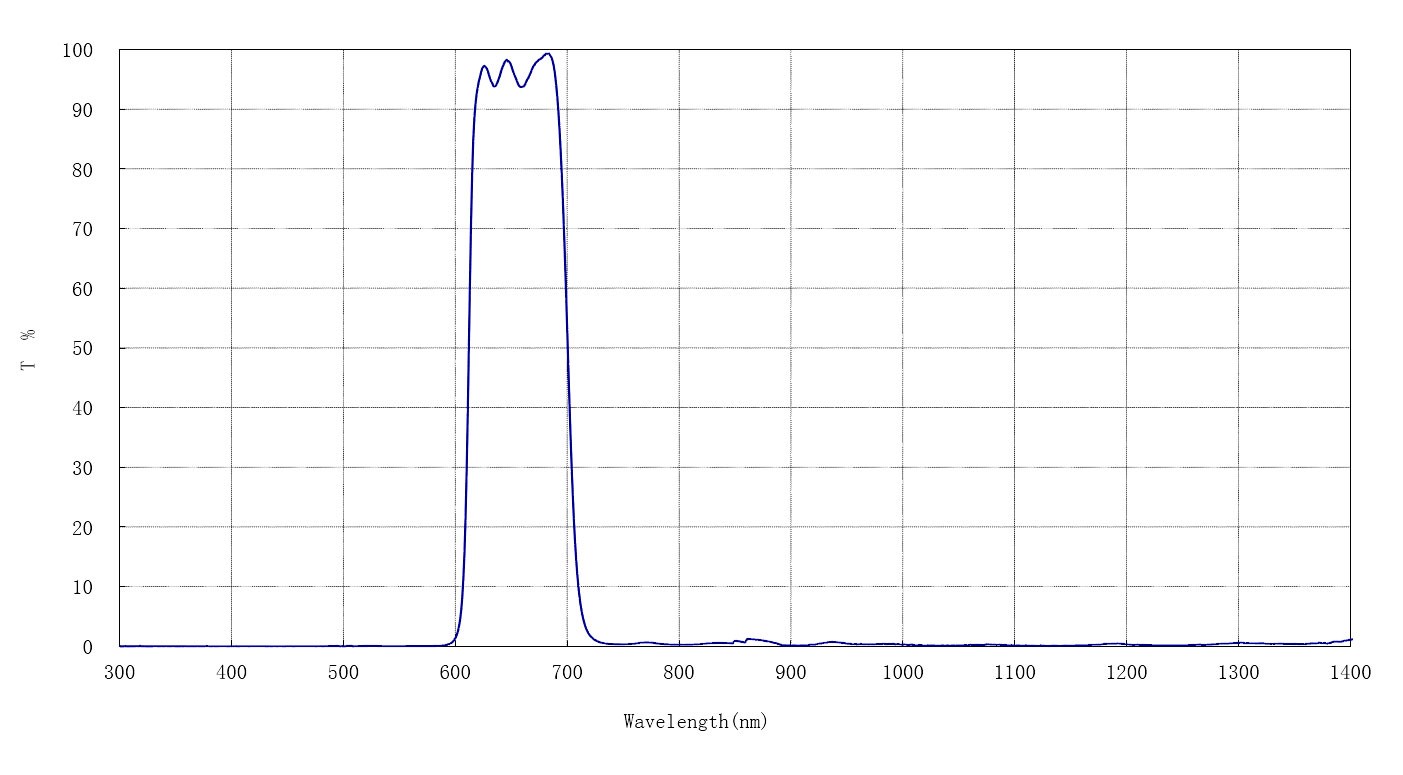
Transmission spectrum of a Baader D-ERF
An older filter type are simple ERF filters made of red glass. In practice, there were three different types of these ERF filters made, each with its own disadvantages. The cheapest version was made of Aero Glass, which has been used since the 1980s. They let most of the red light (down to 580 nm) pass through and usually did not have very good optical quality. The filters with better optical quality used Schott RG610 or RG630 (or comparable) glass, which block up to 610 or 630nm respectively, but offer no protection from infrared radiation. The energy load for the etalon is therefore higher.
As third option, sometimes yellow ERF-Filters can be found – but they offer almost no protection against energy, as a look at the solar spectrum shows, and should be avoided at all costs. They are only a little bit better than no ERF at all.
As these Energy Rejecting Filters are placed in front of the objective lens, the demands on the optical precision are the same as for the front lenses, so that they are not cheap.
ERF – behind the front lens
Therefore, it becomes attractive to install the Energy Rejection Filter close to the H-alpha-filter, so that a smaller diameter is sufficient. This option is often discussed, especially in the case of self-builds. It has a few disadvantages, among others:
- The inside of the telescope can heat up, which can cause seeing problems inside of the telescope. Thus, higher magnifications can't be used, and such a solution becomes mostly interesting for smaller telescopes, which can't magnify that high, anyway
- If the tracking is not perfect and the sun moves out of the field of view, it can shine on and damage the inside of the telescope – just as when projecting the image of sun

SunDancer II H-alpha Filter (#1363056 , € 3545,- )
Sometimes – not only on ATM-websites, but also by some dealers – a yellow ERF-front-filter or even a UV/IR-Cut-filter in front of the star diagonal (and thus in in front of the complete H-alpha-Filter-unit) is recommended as Energy Rejection Filter for these small H-alpha-systems. But a look at the solar spectrum shows the problems of this concept: Only a small fraction of the sun's energy is in the UV/IR part of the spectrum at all; while most energy is in the visible part.
The idea probably originates from visual observation of the sun in white light. There, a UV/IR blocking filter makes sense if you are not sure that the solar filter attenuates the visible light and completely blocks the invisible UV/IR radiation, too. For the eye, unfiltered UV/IR radiation is harmful because we do not notice it; for the filter system of an H-alpha filter, it is not a big problem: if it heats up the filter too much, you can see it in the temperature display and the decreasing image quality long before any damage occurs - unlike in the eye.
A simple UV/IR filter or a yellow filter is thus a bad choice as the only Energy Rejection Filter, as it lets most of the solar energy passes through it.
Our deep sky filters (Halpha, UV/IR and all others) are not suitable for use in a solar telescope near the focal point. They are designed for use in the night sky. The thin filter glass cannot withstand the concentrated solar energy and the mount cannot give the filter glass the necessary room to expand when heated. The filter will inevitably burst if you use it in a solar telescope near the focal point.
For solar observation, our deep sky filters can only be used as an additional safety (e.g. in the eyepiece or in a camera adapter) if an energy camera adapter), if an energy protection filter dampens the solar energy and they are not exposed to it unprotected near the focal point.
With home-made solutions (such as modified PSTs), you must ensure that all filters make sure that all filters fit together. Our Deep Sky filters are NOT intended as a replacement for (D-) ERF pre-filters or even as block filters for solar telescopes and solar filters from other manufacturers such as Coronado or Lunt! Please always use only the recommended accessories from the manufacturer of your solar/H-alpha telescope, and do not do not combine untested filters with your H-alpha filter/telescope. filter/telescope. This can cause damage to your equipment (telescope, solar filter, camera) or even your eyes! We strongly advise against from experimenting on the sun and therefore accept neither responsibility responsibility or liability if damage occurs during your own experiments! damage occurs during your own experiments!
The purpose of an ERF is to protect the expensive etalon from heating up beyond its operating temperature (and in no case beyond the highest storage temperature). If the operating temperature is exceeded, the central wavelength shifts away from the H-alpha line. An electronic temperature control with cooling counteracts this as far as possible. In earlier times, when 4" f/15 telescopes were used for H-alpha observation and no ERF filters could be used, the telescopes were simply stopped down to f/30 - and if the filter became too warm, the objective was covered until the filter had cooled down again. These observation breaks are still a good idea today – if the filter gets too hot, it will be damaged beyond repair.