

Update May 4th, 2022:
After many customer feedback about our CMOS-Optimized Narrowband filters, we learned that it is necessary to finetune our current f/2 Highspeed filters into two filter categories of Ultra-Highspeed filters for f/2 (working range f/3 (working range f/2.3 to f/3.4). Further Information about this as well as a detailed whitepaper can be found in our Blogpost Preshift and further Information concerning Baader CMOS-Filters.Update October 1st: New LRGB-Filters have been added to the line of CMOS-optimized Baader Filters. The post below has been modified to reflect these changes.

Various Baader Planetarium Print Advertisements from 1966 and later years
WE FOUND THE WAY
... to finally and cost-effectively tackle the problem of filters being accused of creating unbearable halos when put into close vincinity of correcting lenses – in conjunction with latest generation CMOS-chips. Hence we introduce our four new families of Baader (Ultra) Narrowband / Highspeed filters:- 6,5 nm Narrowband Filters, CMOS-optimized – for > f/3.4
- 3,5 / 4 nm Ultra-Narrowband Filters, CMOS-optimized – for > f/3.4
- 6,5 nm f/2 Highspeed Filters, CMOS-optimized – for ≤ f/3.4
- NEW: 3,5 / 4 nm f/3 Ultra-Highspeed Filters, CMOS-optimized – for f/2.3 to f/3.4
- CHANGED: 3,5 / 4 nm f/2 Ultra-Highspeed Filters, CMOS-optimized – for < f/2.3 (previously f/3.4 to f/1.8)
 Update October 1st: As well as our new CMOS-optimized LRGB Filters
- RGB-R (595 – 690 nm) Bandpass Filter
- RGB-G (490 – 580 nm) Bandpass Filter
- RGB-B (400 – 510 nm) Bandpass Filter
- UV/IR-Cut / L-Filter (420 – 685 nm)

New CMOS-optimized Baader filters
This new generation of Baader CMOS-filters features:

- Increased contrast, matched for typical CMOS quantum efficiency and s/n ratio
- Reflex-Blocker™ coatings, for largest ever freedom from halos, even under most adverse conditions concerning aux-optics
- (Ultra) Narrowband/Highspeed: Ever more narrow passbands
- (Ultra) Narrowband/Highspeed: FWHM on each filter category carefully designed to allow for 1:1:1 exposures
- Identical filter thickness to existing standards, with utmost care for parfocality
- Blackened edges all around, with filter-lead-side-indicator in the form of a telescope-sided black outer rim, to additionally eliminate any reflection due to light falling onto the edge of a filter
- Each filter coated individually, with sealed coating edge (NOT cut out of a larger plate with coatings left exposed, read more)
- Life-Coat™: evermore hard coatings to enable a non-aging coating for life – even in a most adverse environment


Don´t be misled.
These all new CMOS-optimized filters work magnificently with all existing digital camera technologies, be it CMOS or CCD. However – an owner of CCD-camera-technology will still find our previous, extremely affordable, narrowband filter technology to be fully apt for excellent imaging. But: "the Better always is enemy to the Good".In the future...
Similarly designed Photometric Filters (featuring identical standard thickness alike all our filters as well as all standard sizes) are under preparation for the science world in the form of SLOAN/SDSS and modern BVR (Bessel-conform) filters – likewise using our Reflex-Blocker coating technology, to be fully suitable for 24/7 operation.Images results and test reviews
UPDATE: Testers of regular production series filters
Markice Stephenson

RASA 8
The Celestron RASA 8 and the Baader High-Speed Ultra-Narrowband filters are a perfect match. I’ve noticed a couple of things off the bat about these new filters: 1. The narrow bandpasses contributed to stronger and cleaner signal and helped maximize the time under heavily light polluted skies. In only ~4 hours, I was able to pick up the upper tail / H-alpha filaments on the Eastern Veil Nebula that I simply wasn’t able to pick up on any other attempt of this target.2. That there were no profound halos. 52Cyg is a decently bright star near NGC 6960 and the new Baader H-alpha and [O III] filter handled it well. I didn't see any reflections of my cable router in the images or anything that would warrant further inspection. I should disclose that my sole test of the [O III] filter was on NGC 6960, as I was only slewing to H-alpha objects in Cygnus to avoid switching filters on the RASA. As I began one night on [O III], my luck in clear nights ran out. I intend to test this filter further, but the initial results are incredible. During the week of imaging, however, I was able to gather over 20 hours total of these 6 Ha images: Butterfly Nebula (IC 1318), Western Veil (NGC 6960), Eastern Veil (NGC 6992), North America Nebula Crop of Cygnus Wall (NGC 7000), The Tulip Nebula (Sh2-101), and The Crescent Nebula (NGC 6888). The shortest of the fully integrated images being the North America Nebula, which was only 1 hour and 18 minutes. The longest of the bunch being the Eastern Veil, which was 5 hours and 8 Minutes.NGC 6960 OIII - 34x120s exposures for a total of 1hr 8mins, -10C, 120 Gain; Equipment - RASA 8” Telescope and ZWO 294MM Pro Camera, August 6th, 2021
© Markice Stephenson


NGC 6960 H-alpha - 100x120s exposures for a total of 3hr 20mins, -10C, 120 Gain; Equipment - RASA 8” Telescope and ZWO 294MM Pro Camera, July 31st & Aug. 2nd 21
© Markice Stephenson

NGC 6888 H-Alpha - 115x120s exposures for a total of 3h 50mins, -10C, 120 Gain; Equipment - RASA 8” Telescope and ZWO 294MM Pro Camera, August 1st, 2021
© Markice Stephenson

NGC 6992 H-alpha 154x120s exposures for a total of 5h 8mins, -10C, 120 Gain; Equipment - RASA 8” Telescope and ZWO 294MM Pro Camera, August 3rd, 2021
© Markice Stephenson

Sh2-101 H-alpha - 129x120s exposures for a total of 4h 18mins, -10C, 120 Gain; Equipment - RASA 8” Telescope and ZWO 294MM Pro Camera, August 4th, 2021
© Markice Stephenson

NGC 7000 H-alpha - 39x120s exposures for a total of 1hour 18 minutes, -10C, 120 Gain; Equipment - RASA 8” Telescope and ZWO 294MM Pro Camera, August 5th, 2021
© Markice Stephenson

IC 1318 H-alpha - 122x120s exposures for a total of 4hours 4mins, -10C, 120 Gain; Equipment - RASA 8” Telescope and ZWO 294MM Pro Camera, August 5th 2021

NGC 6960 Ha/OIII/OIII - 134x120s exposures for a total of 4hr 28mins, -10C, 120 Gain, Equipment - RASA 8” Telescope and ZWO 294MM Pro Camera
© Markice Stephenson
Chris Hendren (Technical Support Manager at Celestron Torrance/CA)

IC 1318 and Barnard 347 in Cygnus, © Chris Hendren
Recently, I lucked out and had clear skies until at least 2 AM for 3 nights in a row from my Bortle 9 back yard sky in overwhelmingly-bright Long Beach, California. That let me test out the new Baader 6.5nm CMOS-optimized high-speed filters with the RASA 8 under very tough conditions. Except for the bright magnitude 2.2 star Sadr (Gamma Cygni) in OIII and a much lesser extent in SII, there were no haloes to be seen on any stars with 5 min exposures at f/2.0. I was able to easily minimize the halo to a level I felt comfortable with in a couple steps in Photoshop. I am extremely happy with this result. Chris Hendren, www.hendrenimaging.netImage Specs: Celestron RASA 8-optics and CGX-mount, ZWO ASI2600MM-P, Baader 6.5nm CMOS optimized High Speed Ha, SII, and OIII filters. 38x5 min SII, 35x5 min Ha, 37x5 min OIII at -10 C (550 min total exposure) HaSHO aquired in NINA and processed in Deep Sky Stacker, PixInsight, StarNet++, and Photoshop CC.

Central Cygnus HA - TPO180, ZWO2600MM, Baader 6.5 nm HA

UPDATE: I tried the Baader 6.5nm High Speed HA filter with an f/4.5 TPO Ultrawide (Askar FMA180 clone) scope just to satisfy my curiosity on how slower scopes worked with the high-speed filter. I binned 2x2 to compensate for the reduced signal and then shot 46 x 2 min exposures unguided near Gamma Cygni. ~72% QE at H-alpha with the ZWO ASI2600MM-P certainly helped. I will likely have a lot more trouble with SII and OIII at the slower f/ratio, but this experiment worked pretty well. No calibration frames. Processed in DSS, PixInsight, and Photoshop CC.New images 30th August 2021: I had two good nights this last weekend, so I decided to try an HOO narrowband combination on IC 1396 as I had no sulfur data. The green channel is actually 25% HA and 75% OIII, while HA is mapped to Red and OIII to blue. This was a nice way to get a “close to RGB color” narrowband image from my Bortle 9 skies with a bright moon up. Celestron CGX and RASA 8, ZWO ASI2600MM-P, the above mentioned Baader filters. 130 min HA and 160 min OIII (5 min subs) at -10C, acquired in NINA. Processed in DSS, PixInsight, and Photoshop CC.IC 1396 with Celestron CGX and RASA 8, ZWO ASI2600MM-P, © Chris Hendren

Prototype Testers


Andreas Bringmann
One of our first testers is Andreas Bringmann, owner of a 2.6m Baader Classic Dome and renowned Astro-Photographer – see his images on www.astrobin.com/users/equinoxx/. The all new f/2 Ultra-Highspeed Filters not only lead to amazing images but even enabled the photographic proof of the newly discovered planetary nebula StDr13, check out the detailed test review .I would like to emphasize, that the opportunity you have given me to test the new CMOS-optimized filters has been for me, an astro-amateur, like winning the lottery! Andreas Bringmann, www.astrobin.com/equinoxx/

NEW DISCOVERY - Strottner-Drechsler 13, taken with Baader H-alpha Highspeed Filter
© Andreas Bringmann

Sh2-232 & friends, taken with Baader H-alpha, S-II and O-III ULTRA-Highspeed Filters
© Andreas Bringmann
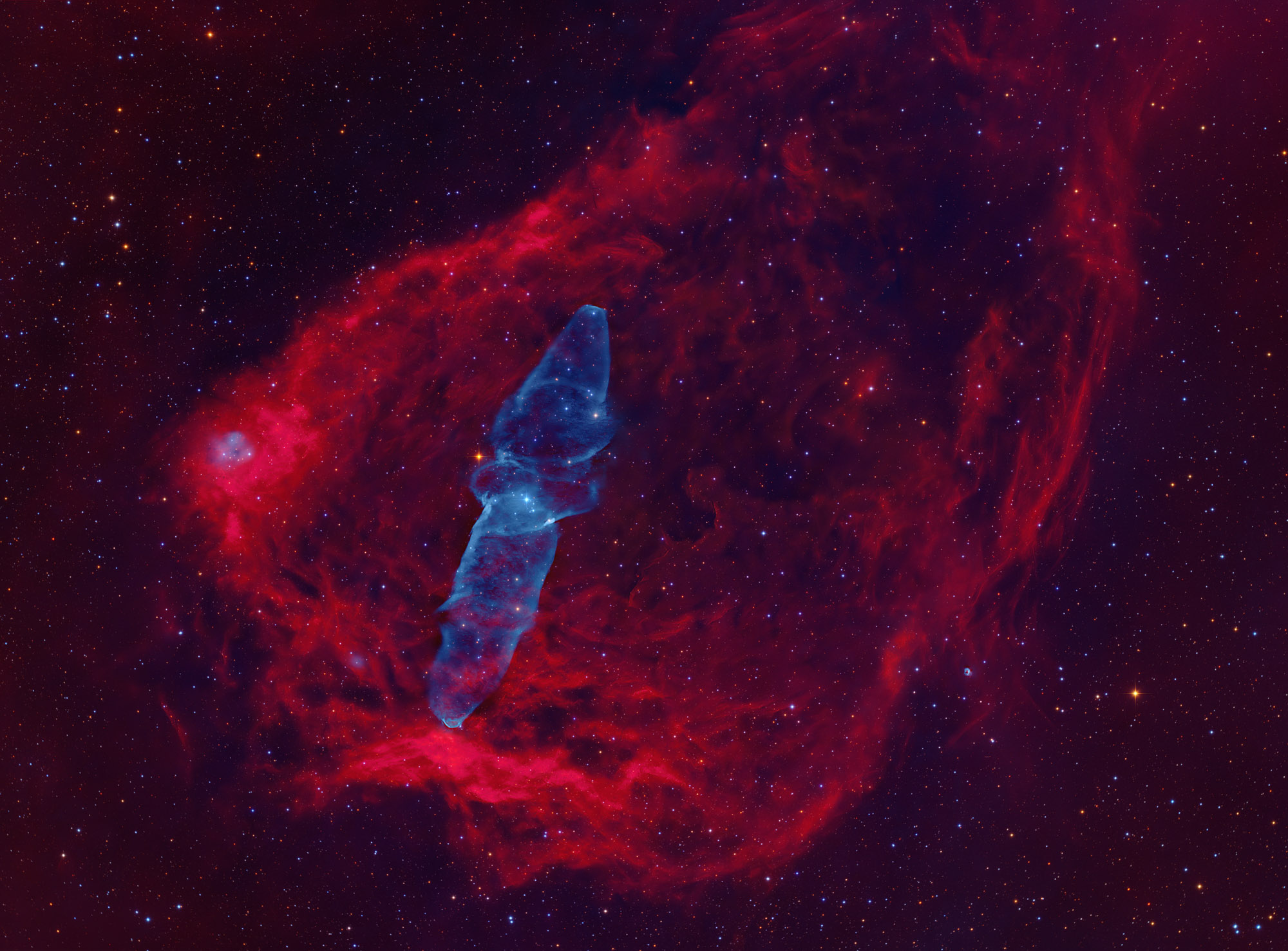
Ou4 an Sh2.129, taken with Baader H-alpha and O-III ULTRA-Highspeed Filter
© Andreas Bringmann

Sh2-308, taken with Baader H-alpha and O-III ULTRA-Highspeed Filters
© Andreas Bringmann
Now Mr. Bringmann had the opportunity to test the new CMOS optimized Baader 5.5nm H-Beta filters:
First of all, I would like to thank you very much for allowing me to test the new Baader filters and I can report that the new CMOS-optimized 5.5nm H-beta filter works photographically perfectly even at f/1.9! Andreas Bringmann, www.astrobin.com/equinoxx/The new CMOS-optimized 5.5nm H-beta filter was compared against the old 8.5nm H-beta filter from 2014, which was in Mr. Bringmann's possession.
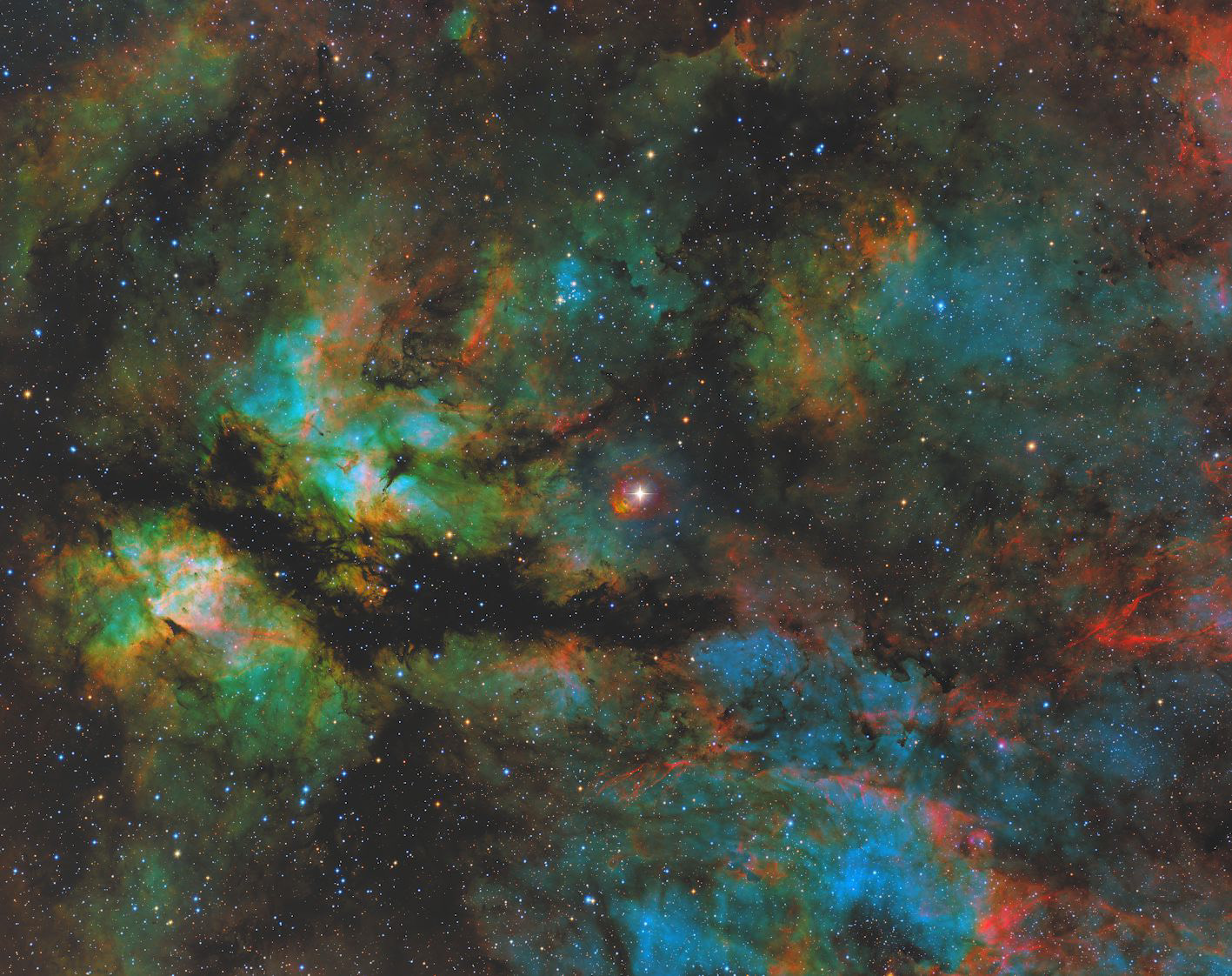
„Sard region: the first test of the new H-beta filter (5.5nm) – CMOS-optimized“
Christoph Kaltseis

after almost 1.5 years of constant tests of always new prototype runs of Baader filters in four different filter categories, I do conclude that the outcome superseeds my expectations, especially considering the prices. Christoph Kaltseis, www.cedic.at

IC1396, taken with Baader H-alpha, O-III and S-II ULTRA Highspeed Filters
© Christoph Kaltseis

IC1318, taken with Baader H-alpha, O-III and S-II ULTRA Highspeed Filters
© Christoph Kaltseis

M31 (SuW Astro-Poster with full story), taken with Baader H-alpha and O-III ULTRA Highspeed Filters
© Christoph Kaltseis

NGC7000, taken with Baader H-alpha and O-III ULTRA Highspeed Filters
© Christoph Kaltseis
Julian Shroff

NGC7000 with RASA 8, taken with Baader O-III and H-alpha ULTRA-Highspeed Filters
© Julian Shroff
After initial testing, I was pleased to find that the new CMOS-optimized Baader filters with reflex blocker coating work great. With the much narrower passages, there is hardly any light pollution, but plenty of signal and contrast. There are also no halos or reflections, even with very bright stars, which I have never seen before on f/2. I used the freshly arrived highspeed filters for a quick snapshot of NGC7000 with my RASA 8. The image consists of 5x120s O III and 15x120s Ha, so a 40 minutes bicolor image. This definitely shows what can be done with a fast system and good filters. I don't like to expose less than 10h, but with such bright nebulae I would be done after 4-5h. Julian Shroff, Instagram, YoutubeAlso a quick first test with the highspeed H-alpha filter on Deneb with 30s, as well as 60s shots shows the difference clearly in my eyes. There is much less unwanted light coming through and also the slight halo, which is present with other filters I have used so far, has completely disappeared even with an extreme stretch.

Deneb at 30s, taken with Baader H-alpha ULTRA-Narrowband Filter
© Julian Shroff

Deneb at 60s, taken with Baader H-alpha ULTRA-Narrowband Filter
© Julian Shroff
Last night (03.May 2021) it was clear for a short time. I have now also made a few 30s and 60s exposures of Deneb with the O III filter. On the 30s images the image looks perfect, on the 60s there is a very faint halo - at maximum stretch. Considering that with other O III filters I used to have halos on virtually every even remotely bright star, I find this very satisfying.

Deneb at 30s, taken with Baader O-III ULTRA-Narrowband Filter
© Julian Shroff

Deneb at 60s, taken with Baader O-III ULTRA-Narrowband Filter
© Julian Shroff
Ian Aiken
Our british customer has been testing our new CMOS-optimized filters in combination with a QHY 268M camera (read more about that here).I'm very impressed with the Baader UNBs and managed to get some H-alpha data under Bortle 7 skies with my new CMOS camera. Having used previous Baader high speed filters on my RASA 11, I can confirm that these are a step forward in conjunction with the RASA optical configuration, that is putting so many lenses very near in front of the filter. These new UNBs definitely are improving contrast with the RASA and helping me to keep stars under much tighter control. The UNB-OIII filter likewise has improved considerably with the Frontside Reflex-Blocker technology, with no halos recorded in this images data (unfortunately due to the weather the data is incomplete to make a pretty bi-colour picture). Ian Aiken

IC405, taken with Baader H-alpha Ultra-Highspeed Filter
© Ian Aiken

O-III stack from the same FoV, taken with Baader O-III Ultra-Highspeed Filter © Ian Aiken

Crop of IC405, with stars removed
© Ian Aiken