Baader Planetarium

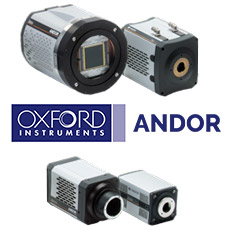
Andor sCMOS range: Balor, Marana and ZL41 cameras for Physics & Astronomy

# Andor_sCMOS
Price:
This product is not for sale online. If you're interested, please:

All details and technical specifications about the Andor sCMOS-series can be found in the Downloads
Show more
  • Extremely low read noise down to 0,9 electrons (much lower than comparable CCD cameras)
  • High resolution cameras ranging from 4.2 MP up to 16.9 MP and pixel sizes between 6,5 µm and 12 µm
  • No mechanical shutter (electronic only)
  • Quantum efficiency up to 95%
  • High frame rates (up to 100 fps) at full frame
  • Higher frame rates possible through ROI selection
  • High dynamic range of up to 53.000 : 1

Important note:

The products of Andor Technology are not in stock and can be ordered from the manufacturer on request. Please contact us in advance by email if you would like to place an order.

Andor cameras in worldwide use

Get an oveview of different customer projects utilizing Andor products:

Application specific projects:


Show more

Andor Technology’s sCMOS camera series (Balor, Marana, ZL41)

Andor’s scientific CMOS (sCMOS) cameras represent a breakthrough technology based on next-generation CMOS Image Sensor (CIS) design and fabrication techniques. Because of their special characteristics - extremely low read noise and fast frame rates - they are ideal camera solutions for various applications in physics and astronomy.

The Balor, Marana and ZL41 sCMOS cameras are specifically designed to provide the highest level of sensitivity (i.e., front and back-illuminated sensors). In contrast to previous CMOS or CCD technologies, these cameras offer maximum sensitivity, resolution, speed, and field of view at the same time. In addition, the sensors of the Balor and Marana can be cooled down to -30°C, -45°C or -40°C, thanks to the vacuum sensor enclosure technology.

Furthermore, Andor’s Balor, ZL41 cameras allow to select rolling as well as global shutter modes, whereas global shutter is similar to a ‘snapshot mode’.

Balor - Andor’s game-changing, very large area sCMOS camera for Astronomy

Balor features an enhanced FoV 16.9 Megapixel, 70mm diagonal front-illuminated sensor, coupled with high speed and low read noise capability. The Balor sCMOS has a read out rate of 18.5ms, offering 54 fps at full frame and read noise of <3 electrons.

Marana

The Marana utilizes back-illuminated sCMOS sensors with 4,2 Megapixels and a quantum efficiency of up to 95%. This camera model is available with sensors of 11 µm and 6,5 µm pixel size. One of the sensor options also features UV opimization with high sensitivities in the wavelength range between 250-400 nm.

ZL41

The ZL41 sCMOS cameras, with read noise of only 0,9 electrons, can provide 100 fps (via CameraLink connectivity) at full frame (higher frame rates possible by using ROIs). The ZL41 is available with two front-illuminated sensor formats: 5,5 Megapixel and 4,2 Megapixel with pixel sizes of 6,5 µm. The ZL41 5.5 offers rolling and true global shutter functionality, whereas the ZL41 4.2+ has rolling shutter only, but provides a higher quantum efficiency of 82% peak QE.

Typical Applications:

  • Space Debris Tracking, SSA
  • Solar Astronomy,
  • Photometry,
  • X-Ray Astronomy,
  • Exoplanet Studies,
  • Synchroton Facilities,
  • High-Speed Spectroscopy (e.g., Marana and ZL41for Multi-Track and Hyperspectral Imaging)

Further information about Andor’s sCMOS camera solutionss can be found on Andor Technology's website.

Please note: We offer ANDOR cameras exclusively for astronomical applications and satellite tracking. This is in response to requests from companies, institutes and amateur astronomers to integrate these high-quality special cameras into telescope systems and observing stations.

In case you have further questions, please contact us via kontakt (at) baader-planetarium.de

Please note that additional information and spec sheets are available in the “downloads” section.

Show more

Andor sCMOS range: Balor, Marana and ZL41 cameras for Physics & Astronomy

Product Details

  • SKU
    Andor_sCMOS
  • Application
    Scientific Cameras
  • Manufacturer
    Andor

Imaging Features

  • A/D Conversion
    12bit and/or 16bit (depending on model)
  • Dynamic Range
    up to 53.000 : 1
  • Maximum Frame Rate
    up to 100 fps (full frame)
  • Monochrom or Color?
    Monochrome
  • Peak QE
    up to 95%
  • Read Noise (e- RMS)
    down to 0.9 electrons
  • Shutter
    No mechanical shutter (only electronic)

Additional Features

  • Anti-Dew Heater
    No
  • Cooling
    down to -45°C
  • Desiccant Socket
    No

Sensor Information

  • Sensor Size
    16.6 x 14.0 mm bzw 13.3 x 13.3 mm (Zyla) | 16.6 x 14.0 mm (Neo) | 22.5 mm x 22.5 mm bzw. 13.3 mm x 13.3 mm (Marana) | 49.5 x 49.2 mm (Balor)
  • Sensor type
    BSI CMOS – Back-side illuminated
    FSI CMOS – Front-side illuminated
Show more

Customer Reviews

5.0
reviews
Tell us what you think about this item!

Top customer reviews

Christoph Kaltseis
Rating
10
Merope Ghost
Der Stern Merope in den Plejaden hat nahe am Stern einen sehr netten kleinen Nebel; Wenn alles passt und Seeing kann immer besser sein, hier bei 2,1" im Mittel kann man mit einem Hobby Teleskop schon Details erhaschen. Hier mit dem C14 Edge HD f10.85 = 3852mm Brennweite und 0,33" Pixel Scale als LRGB;
Top Kamera in allen Belangen und Verarbeitung!
nichts!
Christoph Kaltseis
Rating
20
M42 - Der Kern aufgelöst
Protoplanets made visible in the heart of Orion (Andor Marana w. C14 Edge HD/f10.85 = 0.34“ arcsec) such kind of data set rested in my dreams since long.time. An ideal number of UHC-L frames, balanced w. RGB and an impeccable camera - what a dream come true. This is true "Lucky-imaging" Each subframe is just signal - no noise at all. Fast changing air transparency really was my problem during these nights. Countless subframes needed to be inspected/measured individually for best selection. FWHM weighting of Green and Blue are very similar, w. Red being added more prominently. UHC-L subframes are balanced between Blue/Green and Red. The result is a proof that the mechanical backfocus of my setup is an ever so tiny bit too long (maybe 0.2/0.3 mm). I will still need to change this. But still! This camera is a monster. All usable datasets are within a range of 0.4 FWHM. Special mention should be made of the HDR of the Andor Marana. The seeing was okay, because 3852mm focal length at -6 degrees Dec: is not a state were one could say : I'll take a quick picture now. I have already taken pictures of the M42 at 2700mm with 11 and 6 micron, but the Marana is really extraordinary at this focal length when comparing my older results. The Baader UHC-L filter was used for 7.5 min. The balance of the Baader RGB is proprietory. Now this is the deepest heart of Orion - and a living heart as well. It beats silently for eternity. Have a nice weekend – Christoph
Show more
Top quality and QE - Deep Sky Camera
nothing
Christoph Kaltseis
Rating
20
NGC2392 - Andor Marana im HDR Mode
Lucky Imaging ist eine Erscheinung die sich in den letzten Jahren ausgebreitet hat. Für mich ist in dem Zusammenhang die Auflösung in Kombination mit dem Signal wichtig. Die Marana 4BV6X hat eine extrem hohe QE und im HDR Modus viel Dynamik. Das Ergebnis mit dem Baader UHC und dem B Filter als Bicolor Bild. Auflösung und Dynamik als Ziel = Details im Eskimo Nebel. Belichtet wurden ja 10sec im Einzelbild und die besten 92 habe ich zu dem Bild verrechnet- NB.: Kein Schmalband im Einsatz! Optik: C14 Edge HD f10.85 = 0,34" Pixel Abbildung, 10 Micron GM2000HPS...
Show more
Extreme Leistung und Qualität, absolutes Highend Werkzeug!
Nix
Andor sCMOS range: Balor, Marana and ZL41 cameras for Physics & Astronomy

Choose Files

(jpeg, png)

No file(s) chosen

    Latest First